Our whole family was going on a vacation to the Smoky Mountains. Grabbing my suitcase, I ran out to the driveway. Carol was already there with her security blanket thrown over her shoulder and Jimmy, her pink teddy bear, nestled under her arm. Granny was standing beside the car with a small suitcase and her sewing kit, filled with quilt patches she could baste together at night in the motel.
Image credit: Taylor Mortin, Unsplash
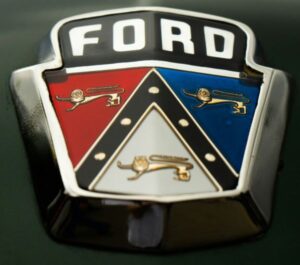
Daddy opened the trunk and stowed the luggage inside. He was so proud of our car, a dark blue 1950 Ford sedan. This was the first brand-new car he had ever been able to afford, and he wanted it to look perfect for the trip. The day before we left, he washed it with soapy water and rinsed it with the hose. Then he coated it all over with carnauba wax and polished it to a shine. The front bumper was made of chrome and shone like sterling silver. Above the bumper, right in the center of the hood, was a decoration that looked like a royal crest. It was divided into red, blue, and silver triangles with a small silver lion in each segment and the word FORD spelled out at the top in capital letters. When he was finished with everything else, he rubbed that hood ornament until it gleamed.
Now everything was ready and it was time to go. I opened the door to the back seat and crawled in. The seat was covered with a gray fabric that felt smooth and soft, kind of like I imagined the fur of a little gray mouse would feel. Carol went over to the other side and got in. All three grownups sat in the front with Mother in the middle.
The tires crunched over the gravel as Daddy backed the car out of the driveway. “We’re off on a great adventure,” he announced. For the past few summers, he had spent several weeks doing research at a place called Oak Ridge. To get there, he had to drive through the Smoky Mountains, and he had fallen in love with these rolling hills. Now he wanted to take the whole family to see the mountains he loved so much.
It felt special to have everyone, even Granny, packed into the car together. I rolled down my window and felt the hot air drying the sweat on my body. From where I was sitting, I could see Daddy at the wheel. He was so tall, and he had beautiful black hair. The steering wheel looked like a toy in his big, strong hands. When he stuck his arm out the window to signal a turn, he could almost touch the cars going the other way with his long, graceful fingers.
About two hours into the trip, things started to get rowdy. These were the days before seat belts, so Carol and I had slid off the seat and were rolling around on the floor, hanging on to the back of the front seat and kicking each other. “Girls,” Mother said as she twisted her head around to look at us,” get back up on the seat.” We both knew not to argue with her when she spoke in her teacher voice.
“If you’re feeling so bored,” she said, “I have an idea. You know how much Granny loves music. Why don’t we sing some of our favorite songs?” She asked Carol to choose a song.
She didn’t have to think long before she said, “Oh, Susanna.” She liked this song because it was about somebody from Alabama, like us. Mother, Carol, and I started to sing. Granny and Daddy didn’t sing along, but they nodded their heads in time to the music.
When we finished the last verse, Mother looked at me. “Becky, what would you like to sing?” I knew more songs than Carol, who was only four and a half. The first one that came to my mind was one of Mother’s favorites, “Carolina in the Morning.” Her voice was strong and sweet as she sang about meeting her sweetie when she got to Carolina in the morning. Maybe she was thinking back to the time when she and Daddy were first married. It was during the Depression, and they were working as schoolteachers in different towns, so about once a month one of them had to travel a few hours by car or bus to spend the weekend together. In between visits, they wrote letters to each other almost every day, but nothing could substitute for actually being together. I knew this song about Carolina was a special one for Mother and Daddy. Carol and I didn’t know all the words, but we followed along the best we could.
We sang a few more songs, and then Mother turned to Daddy and said, “Bert, we should be looking for a place to have lunch. The girls are getting hungry, and we could all use a break.”
One of the best things about vacations was eating in restaurants. Soon we pulled over to a little place on the side of the road. I ordered a grilled cheese sandwich and French fries. Even though it wasn’t a weekend, Mother let Carol and me order soft drinks. My Coke came in a little bottle with a glass full of ice and a straw on the side. All three grownups ordered iced tea. Once everyone had finished their meals and used the bathroom, we got back in the car.
“The pause that refreshes!” Mother said as we were getting settled. She always said that after we stopped to have a bite to eat or go to the bathroom. “Even if you don’t feel tired, you should stop every so often just to stretch your legs.”
Carol didn’t have to take a nap after lunch any more, but as the car sped down the road, she stroked her blanket and cuddled Jimmy. Her eyelids began to droop, and pretty soon she was asleep.
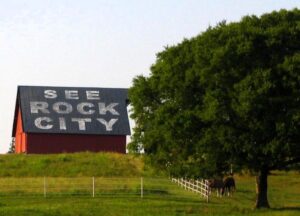
“Look at that!” Daddy said. “We must be getting close.” He pointed to a big barn near the side of the road with See Rock City painted on its roof in huge white letters. He explained that the man who ran Rock City had hired a sign painter to paint this message on lots of roofs along the road as a way to advertise his park. It was just a few miles east of Chattanooga, and we would be going there tomorrow.
After seeing that first barn, we started a competition to count how many of these big signs we could spot. Daddy and I took the left side of the road, and Mother and Granny looked for signs on the right. Granny was very good at this game, and her team was leading. At some point, I must have fallen asleep like Carol because the next thing I knew we were pulling into a motel in Chattanooga.
Right after breakfast the next morning, we piled into the car again and arrived at Rock City about half an hour later. After Daddy parked the car, he turned to Granny. “Mom, it’s pretty steep and rocky. I’m not sure if you’d feel comfortable on the paths here.” Granny was dressed as she usually was—in a printed house dress. She was wearing black leather lace-up shoes with two-inch heels. Unlike my mother, she never wore socks, even inside the house. Instead, she wore nylon stockings rolled above her knees and held up with rubber garters. Always concerned about the needs of others, Daddy continued, “Do you want to come with us? Or just wait here in the car?”
Back home, Granny hardly ever left the house, so her answer surprised me. “We’re on vacation, and I want to see all the sights.”
When we got to a rest area, Daddy snapped a photo. Later, when I saw the picture, I was surprised to see Granny standing next to Carol and looking straight into the camera. In every other photograph of my grandmother, she was turned to the side so that only the left side of her face was visible. Granny was very self-conscious about what she called her “bad eye.” When she was about twelve years old, she had a serious injury. She was bringing the family’s cows home from the pasture, and when she flicked the whip, it flew back and hit her in her right eye. It was very painful, but her parents didn’t even take her to the doctor. A few weeks later, she lost all vision in that eye. To me, the eye didn’t really look that bad, just kind of cloudy and unfocused, but she thought it looked terrible, and she never wanted it to be seen in a photo. Maybe being on vacation, she was so relaxed that for once she didn’t worry about how that eye might look.
After mother and Granny saw the steep path up to Lover’s Leap, the highest point at Rock City, they decided to go to the gift shop instead. Daddy, Carol, and I were determined to make it to the top. The twisting, narrow trail led around giant rock formations. When we reached the summit, the view of the hills seemed to stretch on and on. People liked to say that on a clear day you could see seven states from here, but Daddy said no one could actually prove that.
We took a different trail on the way down. As we walked along, Daddy pointed out some delicate wildflowers growing beside the path. Suddenly we came to a long bridge that went across a deep ravine. As people walked, the bridge swayed back and forth, making a creaking sound. Looking across, Carol started to cry. I didn’t cry, but I was scared too. “I can’t do it,” she sobbed. Daddy knelt down and put his arms around her. “The Indians who used to live here built bridges like this. They knew how to use all the materials they had from nature to make what they needed. These bridges are very strong.”
She was still whimpering when Daddy said, “I know you can do this.” He explained that I should go first. Then he said to Carol, “All you have to do is keep your eyes on your sister and follow her. Whatever you do, don’t look down.” He promised that he would be right behind her. “If you should slip or fall, I will catch you.”
Very slowly, I walked onto the bridge. Holding onto the flexible railing with my right hand, I kept walking. About halfway across, I began to feel more secure and even started to enjoy the rhythmic swaying of the bridge. The next thing I knew, I was stepping onto solid ground. I looked back at Carol. She was smiling.
The rest of the trail back down the mountain seemed easy after that. It was paved with stones and had stone walls on each side that were almost as tall as Carol. When we got down, we found Mother and Granny waiting outside the gift shop. “How was it?” Mother asked.
Carol spoke first. “I walked across a long scary bridge over a deep valley. But I wasn’t scared. I just pretended I was an Indian.”
“Did you know that you might actually be part Indian?” Mother asked. “My father, Bill Stamps, was born in Oklahoma. He told me that his mother was half-Choctaw, so you girls may have some Indian blood. But we can’t be sure because not everything he told me was true.”
As soon as Mother mentioned Bill Stamps, Granny started walking as fast as she could toward the parking lot. She couldn’t stand to hear anything connected with her ex-husband. I knew never to mention his name. He was my grandfather, but I never got to meet him. Granny gave up on her marriage and left him before I was born.
The next day was a Saturday—June 6, 1953. It was only one day, but it seemed to have a whole year’s worth of adventures packed into it.
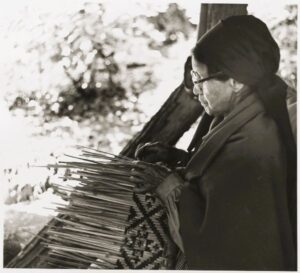
Our first stop was the Oconaluftee Indian Village, just outside the town of Cherokee, North Carolina. Daddy explained that all the land in this part of the country used to belong to several different Indian tribes, but after the White settlers came, they moved them off their land and sent many of them to reservations far away from their homes. Now, some of the Cherokees who still lived here had created this village to show outsiders what their lives had been like before they were forced to leave.
Native American woman weaving a basket, Oconaluftee Village, Cherokee, NC.—Wikimedia, NARA no. 281615, pub dom
When we got to the visitor center, a Cherokee woman in a long dress said that she would be our guide. She showed us all around the village. We saw a man and a woman weaving baskets out of long strips of wood that were soaked for days to make them flexible. We also saw how they made canoes by slowly burning the insides out of a big log. Some of the women used their fingers to weave colorful scarves and belts. I was surprised that the Cherokees didn’t live in tepees like they did in our picture books. Instead, they built homes using wood and clay, sort of like log cabins. To me, they looked cozy, with all family members living together in a big open space. In the middle, there was a circle of stones surrounding the fire they used for cooking and heating.
Before we left the village, our parents told Carol and me that we could use our allowance money to buy something at the gift shop. There was a lot to choose from, and it was hard to decide. Finally, I bought a necklace that looked like it was made of real turquoise, and Carol chose a doll dressed in traditional Cherokee clothes. She was about six inches tall and wore pants and an apron with geometric designs painted on it. She had long black hair and wore a red headband, like the ones we saw being woven in the village.
We had only been back on the road for a few minutes when we came to a big sign that said Welcome to Great Smoky Mountains National Park. “I hope all of you will love these hills as much as I do,” Daddy said as we entered the park.
Driving along the winding road, Daddy had to shift gears as we climbed higher. “Gott im Himmel!” Granny yelled from the front seat. I didn’t know exactly what those words meant, but Granny only said them when she was upset. The car window on her side looked out on a big drop-off. She was twisting a handkerchief around and around her fingers, and sometimes, when we got close to the edge, she closed her eyes. I could understand why she was scared, but I also understood why Daddy loved this place so much. The Smokies weren’t really mountains like the Rocky Mountains out West that I had seen in our Compton’s Pictured Encyclopedia. Daddy stopped at an overlook so we could see them better. Carol and I stood on the very edge looking out over the soft, green hills that rolled on and on, one after another, into the distance.
After about an hour, the grownups decided we needed to stop for lunch. Mother had packed some fruit and sandwiches before we left Chattanooga, and there were picnic tables where you could eat while looking out at the hillsides.
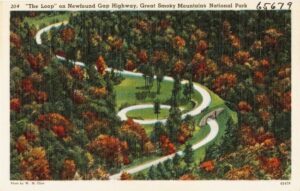
Newfound Gap loop ca 1930s-40s—Standard Souvenirs & Novelties, Inc. (Boston Pub. Lib., Tichnor Brothers collection)—Wikimedia, pub dom
Once we were back in the car, the road got even steeper. A sign said we were approaching Newfound Gap, the highest point on the road. The car kept switching back and forth as the road zigzagged over the mountain range. Pretty soon Carol said, “My tummy doesn’t feel good.” Mother was also subject to motion sickness—she couldn’t even stand beside us on a merry-go-round—and she too was feeling queasy. Once we got over the pass and started down the other side of the mountain, the road straightened out, and they both began to feel better.
We didn’t talk much as we rode along. We just looked out the windows at the beautiful scenery. We passed some rushing waterfalls tumbling over rocks as they splashed down the hill. Daddy said that June was the peak season for the rhododendrons that grew wild in the park. As we drove along, the roadside was lined with their pink blossoms and waxy green leaves, and beyond them the lush green hillsides, one after another, becoming blue and then a hazy kind of slate gray as they faded off into the distance. After a while, Daddy turned to Mother and Granny. “I’d really like to take the girls on a short walk. Would you ladies like to come along?” They both shook their heads and said they’d just rest in the car.
At the next overlook, Daddy pulled over to the side of the road. There was a sign showing a trail map. Once we got away from the road, it was so quiet. All we could hear was the wind rustling through the trees and birds calling high above. As we walked along, Daddy told us the names of the wildflowers beside the trail: painted trillium, foamflower, speckled wood lily. I loved these names. They made it seem as if the flowers had their own personalities. Daddy reached up to look closely at the branch of an evergreen tree. “This is a Tsuga canadensis,” he told us. “The common name is hemlock. We don’t have these trees in Tuscaloosa. It’s too hot for them.” Gently, he broke off a twig, including some tiny seed cones, and put it in his pocket. “This will be a nice addition to the department’s collections.”
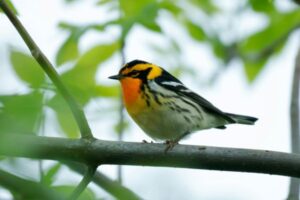
Soon Daddy looked at his watch and said we’d better get back to the car. On the way down, I hadn’t realized the trail was so steep. Walking back up, we had to stop every once in a while to catch our breath. On one of these stops, we heard a thin, high-pitched bird song. Daddy pointed to a nearby tree. All three of us looked up and saw a bright orange splash of color surrounded by the dark green of the evergreen tree where a tiny bird was perched. We stood there in silence, looking and listening. Then, with a flick of its wings, it flew off into the distance. “That was a treat,” Daddy said. “It was a male Blackburnian warbler. They’re quite common here in the Smokies. He was singing to attract a mate.”
Image credit: Daniel Gomez, Unsplash
When we got back to the car, Daddy took his little notebook out of his shirt pocket and made some notes about what we had seen on the walk. I remember thinking how lucky he was to have a job where he could study so many different, beautiful things. To me, his job didn’t seem like work. It seemed like play.
After the hike, Carol and I were both pretty tired. I was almost asleep when the car stopped suddenly. Looking out the front windshield, I could see a long line of cars. “There’s been a bear sighting,” Daddy said. We crept along until we came to a parking area, and he parked the car. Grabbing the camera, he opened the door and climbed out. “Does anyone want to come with me?” We all shook our heads.
We could see him and a few other people walking along the side of the road, and then we saw the bear. It was huge, with matted, dark brown fur. It turned toward our father, who was holding out the camera to take a picture. The bear did not look happy. Slowly, Daddy backed away. The bear just stood there staring at him.
We were practically shaking when he got back to the car. “These bears are not likely to attack a person,” he said, sounding calm. He just sat there in the driver’s seat for a few minutes, and then he took out his notebook and began to write
Took picture of bear coming close to the camera. Someone took a picture of me taking a picture of the bear. He was very close. Ruth, her mother, and the girls would not get out of the car.
Then he dated the entry: June 6, 1953.
As he put the car in gear and drove on, I wondered what Mother would say. She looked over at him, shaking her head, “Honestly, Bert,” she said in a serious voice, “sometimes I think you’re going to give me a heart attack with your biological research!” He just kept driving.
As we got close to Gatlinburg, the town where we would be spending the night, the sun began to fade. Now the mountains were covered with clouds that looked like pillows of smoke—not charcoal gray like the smoke pouring out of a factory but a soft bluish gray that blended with the brighter blue of the sky—almost like a mirage, something I might see in a dream. Looking into the distance as far as I could see, it was almost like listening to music.
Once we got to Gatlinburg, there were lots of motels, and Mother and Daddy chose one with a swimming pool. But Carol and I were too tired to use it. After dinner, when we got back to the motel, we went straight to our room. We took out the things we had bought at the Cherokee Village and laid them on the bed. I could tell that my necklace wasn’t real turquoise. It was made out of plastic dyed to look like turquoise. Carol took the clothes off her small Indian doll. The decorated apron looked like it was made of leather, but it too was just plastic. The doll’s skin was dark, but her features looked like any other White doll. When Carol turned her over, stamped on the doll’s back I saw the words Made in Japan.
Soon we put our new toys on the bedside table and crawled into bed. It was so much cooler here than back home in Tuscaloosa. Snuggled next to my sister in this cozy bed, I thought about all that had happened that day—the long drive through the Smoky Mountains, the beautiful flowers and birds and then the bear. Lying here with the covers pulled up to my neck, what I remembered most clearly was the Cherokee Village we visited at the beginning of the day. I imagined that I was an Indian girl living in one of the houses we saw at the village. Everyone slept in one room and ate together around the fire. They didn’t have a lot of furniture or even toys, but it seemed like a peaceful way to live. And then the White men came and drove them off their land. I knew how sad I would be if strangers forced me to leave my home and move far away from everything that was familiar. I felt so sorry for the Indians. And I hoped this would never, ever happen to me . . .
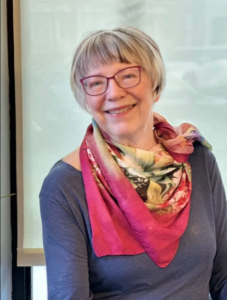
Born in southern Indiana, Rebecca Williams Mlynarczyk spent her early childhood in Tuscaloosa, Alabama. A Professor Emerita of Composition and Rhetoric at the City University of New York, she now divides her time between Brooklyn, New York, and Plainfield, Massachusetts. She is the author of Conversations of the Mind: The Uses of Journal Writing for Second-Language Learners and the co-author of In Our Own Words (with Steven B. Haber) and Basic Writing (with George Otte). From Seed to Tree to Fruit is her first memoir.
Prior to the book’s publishing, Appalachia Bare was honored to feature another chapter entitled Oak Ridge, which you can find at this link:https://www.appalachiabare.com/oak-ridge/
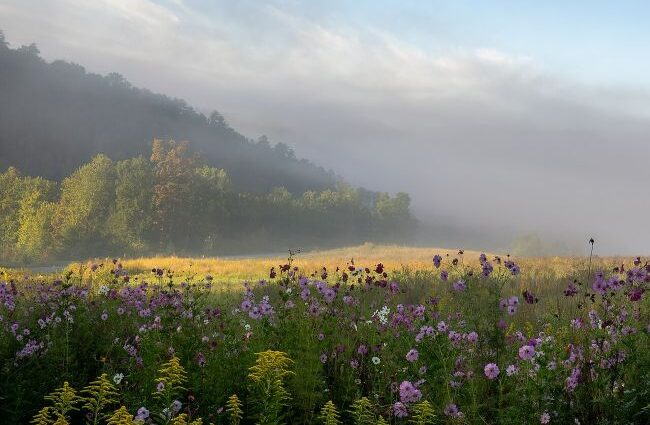
**Featured image credit: “Meadow in the Great Smoky Mountains in Tennessee with namesake ‘smoke'” by Rhododendrites—Wikimedia, CC 4.0