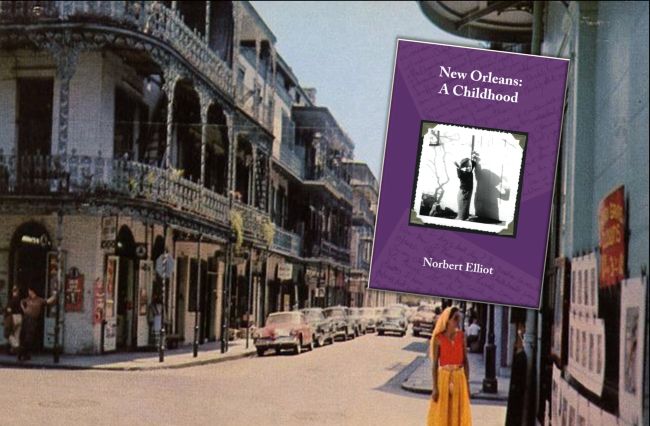

I met Norbert Elliot in 1978 when we were graduate students in English at the University of Tennessee, Knoxville. We bonded as friends while discussing literature and quaffing copious amounts of bourbon. He’d migrated from New Orleans to Knoxville to pursue a Ph.D. in literature. (He would eventually complete a dissertation on the works of Isaac Bashevis Singer, a Polish-born Jewish American novelist whose first language was Yiddish.)
I was intrigued that my new friend’s place of origin was New Orleans, Louisiana, nicknamed “The Big Easy.” As an incipient scholar and writer, I knew NOLA had long served as a muse for such literary luminaries as Tennessee Williams, William Faulkner, and Kate Chopin. I wanted to know what it was about the city’s sultry atmosphere, Creole heritage, and unique blend of romance and tragedy that seemed to provide a perfect backdrop for storytelling. What was magical about the New Orleans ambience, especially for writers?
To my dismay, Norbert set out to dismantle my edifice of false assumptions about the place where he’d lived most of his life, noting that the attractions outsiders found so fascinating distracted from the underbelly of a different city known to locals. According to Elliot, the façade of genteel charm associated historically with New Orleans masked the harsher realities of racism, social inequality, and intractable opposition to change—especially in the 1950s and 1960s, the decades spanning the author’s boyhood.
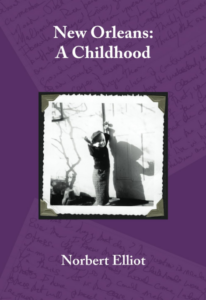
What emerges in the memoirist’s pages is a sensitive boy’s attempt to navigate extremes imposed by hereditary obligations. Ancestral ghosts haunt the fringes of this narrative, refusing to die. The result of meticulous research covering centuries, Elliot’s chronicle documents his French family’s settlement in New Orleans and surrounding parishes while underscoring each generation’s indissoluble connection to the past. Young Norbert stands between poles of opposing energies manifested by his parents.
His mother, Milly, was a stern and imposing figure in her only son’s life, sharing confidences too blunt and disarming for impressionable ears. At one point she confesses, “I never wanted children. Your father did.” Another time she states, “I didn’t want to have you in a Catholic hospital. If something goes wrong, they sacrifice the mother to save the child.” And again, “I was not about to breastfeed you.” The author recalls with stark clarity the matter-of-fact tone used by his mother in making these pronouncements.
His father, Norbert Elliot, Sr., is a less conspicuous figure in the narrative. His despair is palpable at his wife’s knowledge of having married “down.” Her beauty makes her deserving of a worthier man. His son’s oddness disappoints him, compelling his adult offspring to conclude: “The last thing in the world he would have wanted to face was a child who did not know how to catch a ball or run a base.”
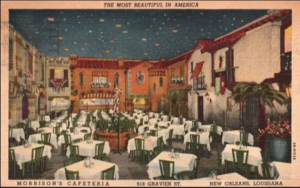
One especially disconcerting scene in the book occurs when the boy’s family is dining at Morrison’s Cafeteria where a Black waiter performs some small service for which Norbert thanks the man followed by the word “sir.” Leaving the restaurant, Norbert’s father harshly chastises his son, warning him never to accord a Negro the sobriquet of “sir” again. Two years later the idealistic child experiences the exquisite thrill of vindication. On April 16, 1962, the Times-Picayune reported that eighty-five-year-old Joseph Rummel, Roman Catholic Archbishop of New Orleans since 1935, excommunicated three prominent parishioners, including a judge, for opposing desegregation. This bold move meant that the racist powerbrokers were no longer able to attend mass or receive communion. Young Norbert had his own thoughts on the prelate’s decisive action:
I remember thinking that, at last, somebody took the messages of Christianity literally. He and I shared an attitude that no one seemed to like. Maybe the nation’s fifteenth largest city with thirty-seven percent of its population Black, would have to change. Then everybody could be sir or ma’am.
Not surprisingly, when the time came for Norbert’s formal education, his parents enrolled him in Catholic school. Louisiana calls its counties “parishes” because of the density of French and Spanish settlers in the territory’s early colonial history. Naturally enough, then, the Elliots’ son would attend the Immaculate Heart of Mary elementary school in Orleans Parish. To the timid boy, even the principal’s name struck fear in his heart: Sister Mary Hildegarde. The faculty, comprised largely of nuns, soon became the bane of the boy’s young existence.
Whatever Milly Elliot expected of her son, he failed miserably to deliver. His report card reflected inconsistent performance and mediocre marks. The nuns’ rigid demeanors and harsh gazes only punctuated his failures, the most prominent being his inability to fit in with other children.
Undaunted, Milly arranged a series of medical and psychological tests for her son. The first examination was with an allergist:
Mother sat with me while the doctor took off my shirt, dotted my back like a checkerboard, and pricked me with a little lancet so that the allergen got beneath my skin. We waited a week or so and drove back to his office to find I was allergic to household dust and pollen. This meant, Mother concluded, that I was allergic to everything. She cleaned the house as if my life depended on it, and I found myself going out less and less during pollen season, from February through June, the second half of the school year. By the end of third grade on June 2, 1961, I had missed one hundred and nineteen days.
However, the regimen of testing didn’t end there. Fostering hope that her offspring might be a late bloomer or that his genius lay dormant beneath a surface of social anxiety and awkwardness, Norbert’s mother submitted the boy to a battery of cognitive evaluations:
I was also tested for intelligence later that year by another specialist . . . Again, there was a trip uptown. I remember the mahogany pocket doors through which I was led, with Mother this time on the other side of them as they slid shut. I drew missing parts in pictures, traced paths through mazes, slipped wooden shapes into matching holes, and answered questions about similarity and difference.
Predictably, the results of the assessment were abysmal:
“You are not as smart as we thought you were,” Mother told me in the car. “You are only of average intelligence.” Then she added something unexpected . . . “And the doctor also said that, by the time you are thirteen, you will kill me with your meanness.”

Far from Halcyon days, the late fifties and early sixties were especially stressful for women. Tranquilizer production spiked. “Mother’s Little Helpers,” as these medications were called, were marketed aggressively to women, especially housewives, to numb the existential dissatisfaction and angst many women felt in their domestic roles. Some women sought to live out their unfulfilled ambitions through their children. The 1960s, in particular, were years when nature vs. nurture was hotly debated. Milly Elliot came down firmly on the side of genetics as an explanation for her child’s dullness:
Something was wrong with my wiring, and nothing could be done to change it. Further, my defect was not from her side of the family. Mother kept this narrative throughout my childhood.
Milly found cultural support for her deterministic position. In a darkly comic episode reminiscent of the writing of Flannery O’Connor (Wise Blood) and John Kennedy Toole (A Confederacy of Dunces), Elliot describes the black and white torture he was forced to endure at various times throughout childhood:
Whenever it was on television, she made me watch The Bad Seed, the 1956 Warner Brothers movie in which Rhonda Penmark, a child exactly my age, kills an elderly neighbor, a child, and a caretaker. After discovering what her child has done, Rhonda’s mother, Christine, the daughter of a serial killer, gives her a lethal dose of sleeping pills and tries to commit suicide herself. Both survive. Rhonda then plans to murder another child and is struck by lightning.
It was understood that I was Rhonda, described by Christine as “a poor deformed child born without pity,” blessed with “a dazzling smile.” It was unclear whether Milly was to be Christine, carrying the serial killer gene, but I thought she might be. When the film was over, Mother would raise an eyebrow. ‘This,’ she said, ‘is what happens to bad children.’
Elliot’s stated purpose in writing this book was to explain to his grandchildren why he left New Orleans, “a city everyone likes,” planning never to return. He has returned, of course, in pages of lived memories resulting in a saga of dynastic woundedness. The author acknowledges that “It could not be otherwise.” However, this tragedy of intergenerational circumstances is not without a feature of redemption. It lies in the author’s willingness to let his cast of family members speak for themselves. Voices in this account echo, refusing to be silenced by time. Instead, they whisper to posterity new beginnings of a story outliving individuals while sustaining loving connections for generations.
To find out more about Norbert Elliot, the author, visit his website: norbertelliot.com as well as purplebreezepress.com.
This gallery is not published.
Featured image credit: Postcard, French Quarter of New Orleans, 1950s or 1960s—Wikimedia, pub dom