When I was young my grandmother brought me
back to the church where she grew up
a holler away from the homeplace
and perched at the crossroads by a creek
in the hills of West Virginia.
The summer smell of heat and hay
followed the farmers
through the white-painted doors
and settled with them in their seats
along two rows of hardwood pews.
The preacher, a carpenter who caught
copperheads with his bare hands
during the work week, inserted forty verses
into his Sermon without glancing down,
and my grandmother whispered:
“See, he’s learned the Bible by heart,
I bet you could be a preacher too,”
and the idea set in that maybe I could.
She and the preacher and everyone there
are gone now, but me, a grey-haired teacher
of anthropology, pinching a piece of chalk
to diagram the branching of Australopithecines
in the Plio-Pleistocene
rather than the miracle of Mary,
a lecturer on the mutations
that curved our tongues and prepared our throats
for the air of language
more than a messenger of any parable
about the Tower of Babel,
passing around an attendance sheet
but not a collection plate,
grading papers instead of forgiving sins,
worrying less about the Armageddon
endgame of it all, fire filling the sky,
than I am curious about that first blush
of a beginning, a cozy group of humans
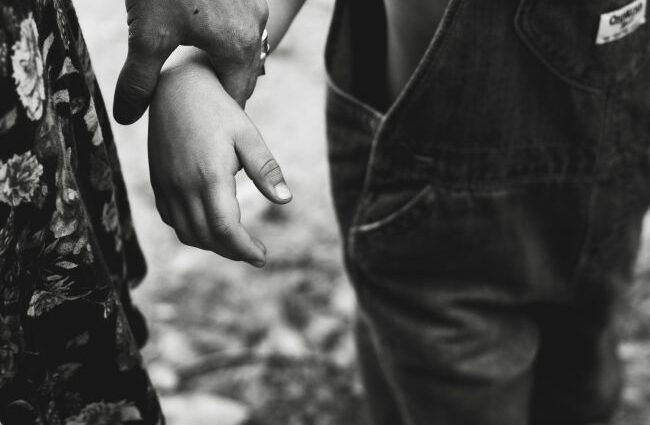
at dawn, when one small boy’s hand
joined his grandmother’s.
Mark Dailey is an anthropologist, poet, and 8th-generation West Virginian currently living in Arizona. After focusing on haiku writing for 10 years, publishing widely in journals and anthologies, he has turned his efforts to free verse. Inspired by classical Chinese poetry on one hand, and by the Romantics and Beats on the other, his poems often combine tones of wistfulness and humor.
**Featured image credit: Gabrielle Meschini—Unsplash
Beautiful poem! It deserves to be savored.