
I drew the short straw that July day in 1991. Two apartment listings cards were posted at the USAF Bitburg Air Base housing office in Germany. I chose the card with a listing closest to the base and gave the other to another officer. My selection was snatched up before I got there. Hers was an aerie nestled on a bluff with a beautiful view of a medieval castle and a lovely river meandering through a pastoral valley below.
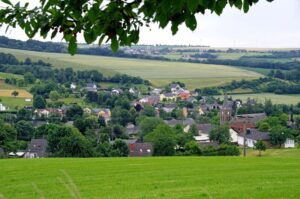

I eventually rented an apartment in the less lofty but peaceful setting of Bickendorf, a tiny village about eight miles north of Bitburg AB. It was on the second floor of a solidly built, mustard-colored stucco house with an attached dairy barn. My spacious one-bedroom bachelor pad featured high ceilings, a modern bathroom, complete with a washer and dryer, and a separate entrance up a stairway from the rear courtyard. A lush vegetable garden bloomed below one window; the other window opened over a fermenting manure pile. Sunlight flooded in with a breeze to flush the rooms with light and barnyard-scented air. The quiet village and country lanes were a respite from the fenced in rules and regulations of the military base.
As typical, at least in this part of Germany, none of the windows had screens. Supposedly, an American once asked his landlord why no Germans had screens on their windows. “How would the flies get out?” the puzzled man replied. I hired a carpenter friend to make some custom screens that could be inserted on the inside of the window frame. I made sure to shoo the flies out before I put them in.
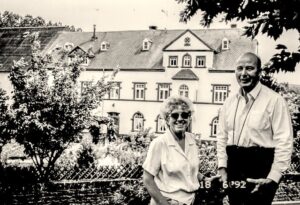
Dieter and Brigeta, my friendly proprietor hosts, lived below me in the farm house. Dieter was a strapping man with a bald dome, a sparkle in his eyes and a vulpine grin. Brigeta, who stood two feet shorter than Dieter, sported a tousle of straw-colored hair and an endearing, gapped-tooth smile. Dieter spoke rudimentary English; Brigeta spoke High German with just a few spare words of English thrown in. Unlike most of the locals around Bitburg, who upon hearing my Tennessee-accented mangling of their native tongue, would grimace and immediately switch to English, Dieter and Brigeta were willing to endure my twangy Deutsch.
I was determined to exceed the typical U.S. citizen’s feeble effort to learn little beyond how to say hello and order a beer. Mark Twain made note of this American deficit in A Tramp Abroad:
I have heard of an American student who was asked how he was getting along with his German and who answered promptly: ‘I am not getting along at all. I have worked hard for three level months and all I have gotten to show for it is one solitary German phrase—ZWEI GLAS (two glasses of beer). He paused reflectively, then added with feeling: ‘But I’ve got that SOLID!’1)“Appendix D: The Awful German Language”
Dieter and I, despite our comically inept conversations, hit it off. Curious about his life as a farmer, I peppered him with questions about his dairy operation. We ventured out to his pastures where he proudly showed off his 28 milk cows. A portable milking machine was attached to his tractor. The pump, driven by a shaft from the motor and coupled by hoses to their udders, milked six cows at a time. Dieter had named all of his cows, Helga and Dollie were two examples, and he swore they understood a little pidgin German. I asked him if he liked milk, he grimaced and gagged out a terse, “Nein!”
Early one morning, he rousted me from bed to witness the artificial insemination of a cow in the barn abutting the house. A veterinary technician lugged in a large thermos-like container that kept the semen at a sub-zero temperature. The vet tech wrestled on a long rubber glove, stuck his arm up the business end of the cow’s reproductive tract and inserted a long catheter with a syringe attached. Once he found the right location—not the G-spot I gathered, given the nonchalance of the cud-chewing cow—he injected the sperm. Dieter proudly showed me a photo of the father, a handsome bull. I dared not ask him how the bull’s sperm was acquired.
Dieter was 6 years old when World War II ended. His father was a teacher, and the family lived in two rooms on the second story of the school house where he taught. The U.S. military appropriated the school, including Dieter’s home. The family moved down the street to his aunt and uncle’s house, the home we were living in now. The Americans made everyone in the village relinquish their guns, a big blow to this hunting community. Dieter traded an old spy glass to a G.I. for a big box of chocolates, a luxury in war-deprived Germany. A few weeks later, the Americans moved on and the French took over that sector of Germany.
Dieter worked from dawn to dusk tending to his cattle and fields. He lamented that the East German and other Eastern European farmers were undercutting the market, causing a drastic drop in the price of milk and beef. Although the farm had been in his family for years, he planned to retire in 18 months. His only son, a PhD candidate in agriculture, had no desire to take over the operation—the ceaseless work was not worth the effort.
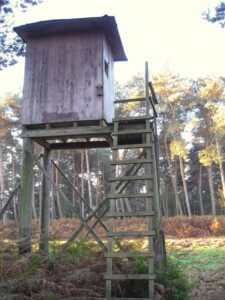

I helped Dieter erect a new Hochstuhl, a hunting stand, at the wooded edge of one of his fields. He mounted his perch on full-mooned nights when he could sight the farmers’ avowed enemy, the Wildschwein (wild boar). The wild pigs rooted in the cultivated fields, destroying the crops. While out on a run, I had seen one of the low-slung, snouted creatures loping across a pasture. Dieter couldn’t believe I had seen the elusive beast, much less in the daylight. He had yet to bag one; that is, until a few days later when he discovered a dead boar a few miles down the highway.
We loaded the spikey-haired, 40-kilogram swine into the back of his jeep and carted her to the barn. Dieter hung her up, gutted her and called the local vet to come inspect the carcass. The meat was past its due date—so much for a roadkill roast. A few days later, I sampled (fresher, I hoped) Wildschwein at a German eatery. The meat, smothered in a thick sauce of mushrooms, onions, prunes and apples, was delicate with no hint of the wild.
One Saturday evening, Dieter invited me for a session in his basement spa. He had a DIY version of the Roman baths: a shower, a full-sized, cedar-paneled sauna, sleeping benches, and a trough-like, metal pool for a cold-water dip. We sweated for a while in the dry heat of the sauna until he poured an aromatic liquid over the rocks, filling the space with a heady, sinus-clearing vapor. After we steamed for a few more minutes, he opened the sauna, handed me a pair of shower thongs and headed for the basement door.
“Where are we going?” I asked.
“To get some fresh air!”
“Oh?” I croaked.
We stood in the backyard, buck-naked, bared to the elements and the neighbors. Fortunately, it was dark, and Germans are refreshingly blasé about unwrapped human bodies. After our healthy dose of garden air, we took a quick dip in the frigid bath. Dieter was tickled by my anguished, high-pitched cries. We headed back to the sauna and repeated the whole process again. Once I got used to airing my timid bits about the premises, the procedure was pleasantly relaxing.
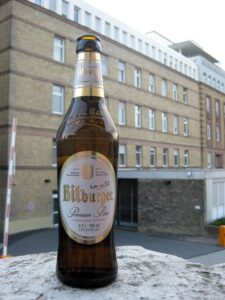

When Dieter wasn’t on the venue for entertainment, just a short stumble from my door was the Gasthaus-Pension Lichter-Weides, a fount of the ubiquitous Bitburger Bier, a hoppy pilsner brewed in its namesake city. Bitburger Bier had two advertising slogans: “Bitte ein Bit (Please, a beer)” and “Abends Bit, Morgens fit (nights Bit, mornings fit).” The morning after the one and only time I tried to match a German beer for beer at our local watering hole, I recast the slogan as “nights Bits, mornings shits.”
Americans referred to the pub/restaurant as “The Pig House,” in tribute to its delicious pork-centered meals. Josef, the jovial, beer-bellied owner, invited me and some other Air Force nurses to his birthday party. In addition to the mandatory Bitburger, Josef served up home-brewed wine, and plates full of meats—smoked ham, roast beef, beef tongue, steak tartare—these villagers were serious carnivores.
By the end of my two-year assignment at Bitburg, I had cleared the linguistic low bar of Zwei Glas. I was fortunate to meet Peter, a convivial native, fluent in English, who enjoyed hanging out with Americans and had the patience to tutor his tongue-tied friend. I was conversational enough to buy furniture, to get directions, and to tell an usher that a drunk guy who had followed us into an opera “…ist nicht mit uns (is not with us).”
While I would never exaggerate the agony of learning German as much as Twain did in his rabidly ethnocentric satire of the language, I will admit to occasionally taking a nap while waiting for a German to get to the key word hanging around at the end of an interminable sentence. German compound nouns were especially daunting. Try wrapping your tongue around this record breaker: Rindfleischetikettierungsüberwachungsaufgabenübertragungsgesetz.
I moved on from my two-year hitch in Bitburg to a hectic 45-bed medical ward at Wilford Hall Medical Center, at the time the largest hospital in the Air Force, in San Antonio, Texas. It was an important career move but a big adjustment. Texan drawls sounded a lot like home, but I missed the bucolic setting, easy pace and cross-cultural connections at Bitburg. I clearly had a case of Fernweh (distance pain, the feeling of wanting to be somewhere else). I sent a carefully constructed letter in German to Dieter and Brigeta bemoaning my fate and pining for the good times there. A few months later I sent a less artful message in German to Peter and received a notice back that my deteriorating Deutsch was awful. By then, as one must do to thrive in the military, I had adapted to my new digs and revved up my work skills to match the busy ward.
Dieter and Brigeta, sadly, died years ago, and nearly all of my hard-earned German has expired as well. Still, I keep a list of German words, including Fernweh, with apt meanings to deploy where English fails—Schadenfreude (harm-joy, getting pleasure out of someone else’s discomfort), Lebensmüde (life-tired) and Sitzflieisch (seat-meat, a feature for enduring interminable meetings)—are but a few. Nowadays in Asheville, North Carolina, thanks to Duolingo, I’m learning a new language and unsettling the local Hispanic population with my Tennessee-tuned Español. I’m not fluent by any stretch, but I’ve advanced well past dos cervezas.
Jim Clark, a retired Air Force nurse living with his wife and daughter in Asheville, North Carolina, was raised in Chattanooga, Tennessee. When he’s not holding down the home front, Jim is likely to be running or biking the surrounding trails and back roads. He enjoys capturing bytes of flora and fauna with a camera sensor and occasionally sentences a few bits to prose or poem.
**Slider image credit: Olly, Pexels
***Featured image credit: David Sager, Unsplash
References
| ↑1 | “Appendix D: The Awful German Language” |
|---|
Jimmy: what a fine and humorous piece! I’m confident Mark Twain would have approved. Indeed, a pleasure to read.
Eddie, thank you and Mark Twain—that’s quite an endorsement!
Hallo Jim,
beim Lesen Deiner Erinnerungen an Deine Erlebnisse in der Eifel habe ich mir Dich und Deine Dir eigene besondere humoristische Art und stark “Tennessee” akzentuierte Aussprache und Ausdrucksweise vorgestellt. Ich kam aus dem Schmunzeln und Lachen nicht mehr raus. Ich freue mich schon auf die nächste Geschichte. Vielleicht erzählst Du dann über Dein Maastrichter Karneval Erlebnis? Ich habe noch ein Foto, welches Dich nach einem nächtlichen Kneipenumzug in einem, eindeutigen “morning shits” Zustand zeigt. Gib Bescheid wenn Du es brauchst.
Hallo Peter,
I’m afraid my rusty German is not completely up to your comment, but I’m glad you enjoyed the story, especially since you were a big part of it. I appreciated your willingness to tolerate my Tennessee accent and warped humor, and benefitted greatly from your tutoring, despite the damage to your auditory system. As to the shenanigans at Maastricht, that story is not to follow, but I would like to see the “morning shits”photo.
Well, I guess Google or DeepL tranlated my comment for you.
The Maastricht Karneval shenanigans photo will follow.