Poke (chiefly Southern U.S. and Midland U.S.): a bag, a sack.
 I have so many things to write about our humble endeavor—exciting news, hopeful opportunities, good changes, and even a spooky story. But first, I want to say that this endeavor to bring Appalachian creativity, talent, and history to the forefront would not be possible without all of you—contributors, submitters, subscribers, readers, perusers, accidental wanderers—walking this path with us. We have been delighted, or “tickled,” as my mamaw would have said, to stroll with you. And we are honored that you chose to do so.
Before our winter break, I listed a series of phrases indicating what to expect this year, and I’d like to dig a little deeper into some of those things.

Submissions
One of Appalachia Bare’s most important goals is for our region’s stories to be told and talents to be recognized. Being chief editor, I adopted a “first come, first published” type policy. I edited written submissions, sent them back to the respective writers for approval, then published the work. My strategy was successful for the first three years. The fourth year, we fell behind. The fifth year, we fell behind and often face forward. We are a small, voluntary staff, tenacious and hard working, but we knew we needed a better system. Now, submissions will fall into four categories, based on the condition or content we receive:
- Ready to publish
- Copy edits before publishing
- Needs work—resubmit after revisions
- Pass—not publishing
While we are thrilled to receive a great deal of submissions, we feel this system is fairer to everyone—submitter and reader and staff. The submissions page will reflect these changes.
One job I loathe as chief editor is sending rejection letters. I’ve received them. As far as I know, all writers have. I have come to realize that not every writing is a good fit for Appalachia Bare but it may be a good fit elsewhere. As a result, we have adopted a new policy where everyone who submits work will receive correspondence indicating one of the four outcomes mentioned above.
Another thing I’d like to clarify is our publishing schedule. Ideally, we publish in a five week rotation—fiction, nonfiction, poetry, visual arts, magazine matters—with new content every week, depending on the genres and submissions we receive.
The Daugherty Series
I began this series with the sincere belief that I could somehow remain neutral throughout the writing process. Byrd Daugherty was a lawman; Daniel Britton Daugherty was a moonshiner. The time? Prohibition. Simple facts. One thing I wanted to remind the reader is that my father was a lawman. I loved him (and still do), but the truth is he was an innately suspicious and oftentimes hotheaded man who, even on his days off, carried a little notepad and wrote details about people and their license plates that he said looked like they were “up to no good.” So while he was in law enforcement, which was a good portion of my childhood and into early adulthood, I lived, heard, ate, and drank his suspicion. At the same time, I understood it. Though I didn’t want to admit it, my past experience skewed my perspective of Byrd Daugherty and his influence as a lawman.
That is until the dream.
I was driving in my dream, somehow veered off the road, and my car crash-landed in a ravine covered in green grass. Someone opened my car door. A mustachioed man leaned in and looked at me. He was thin, white, and wore a cowboy hat. He tugged at my arm and helped me walk toward the back porch steps of an old white farmhouse in the distance. I sat on a step and the man drew closer to me. My eyes were keen with recognition. He was Byrd Daugherty. He leaned down, looked at me face to face, and asked, “Why are you doing this to me?”
I woke from the dream, almost in a panic. It was a message to be more objective and fair. To realize that people are complicated and history is even more so. It shook me, so I haven’t written about the Daughertys since. But I just needed time to process the message, and I’ll pick up the story of my beautiful people again. I would, however, like to apologize to anyone who was hurt by my characterization.
Appalachia Bare news
Sometimes Appalachia Bare encounters various publishers, from books to magazines to music. We had previously published a book excerpt by Rebecca Mlynarczyk entitled “Oak Ridge.” The publisher, Purple Breeze Press, perused our magazine, read some of the content, and asked our associate editor and me if we’d like to publish our own work from the magazine as an anthology. One thing I considered is that this undertaking would be an opportunity for Appalachia Bare to reach a wider audience, and, hopefully, open doors for some kind of annual print publication. So, Edward Francisco and I have a book coming out that will be available this spring! What’s the title? Appalachia Bare.
Contest?
Yes, we’re having another themed contest this year! The information will be forthcoming, so check back with us on a regular basis. Or subscribe to receive an email each week with new content and you’ll be “in the know,” as they say.
AI and Images and Apologies
Appalachia Bare reserves the right not to accept AI content and tries not to use AI images. We apologize because we have been lax and AI images have crept into some page designs. Moving forward, we will not consciously use AI images.
We encourage every person who would like to submit accompanying images with their story or poem or essay to do so. See the art and photography guidelines on our submissions page.
Conclusion
I hope I have been able to catch everyone up on the goings on here in our little corner of the mountains. Appalachia Bare strives to be an online venue that offers some of our mountainous region’s most remarkable creative work. Together, we have been transported inside exceptional tales, cast our eyes on amazing artwork and photographs, felt the beat of Appalachian poetry, toe-tapped to mountain music, and unearthed a history layer by quilted layer. And every writing, art piece, photograph, and composition adds patchwork to that beautifully quilted history. So keep writing or photographing or painting or singing your stories. Submit your best work. We look forward to a creative new year! If you have any questions, please send them to info@appalachiabare.com.
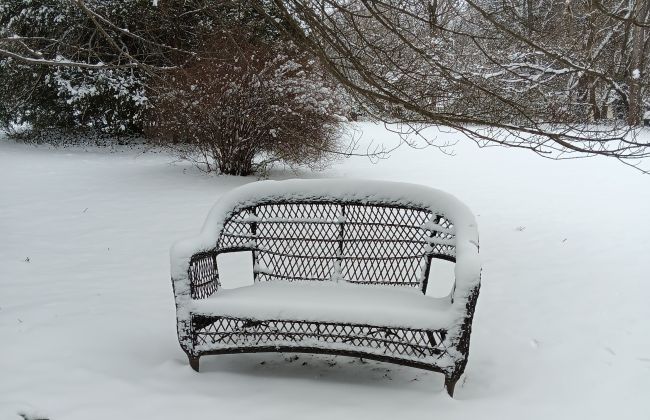
**Featured image: Backyard bench, photog. by Delonda Anderson
Congratulations for AppalachiaBare’s amazing growth and accomplishments! Just one clarification question: Will those who submitted pieces prior to the changes in the submission policy receive a status notice (per the four categories above)?
Thank you, Jim! Yes, and we’re working on contacting everyone in as timely a manner as possible.
Congratulations! I’m looking forward to more of Appalachia Bare!