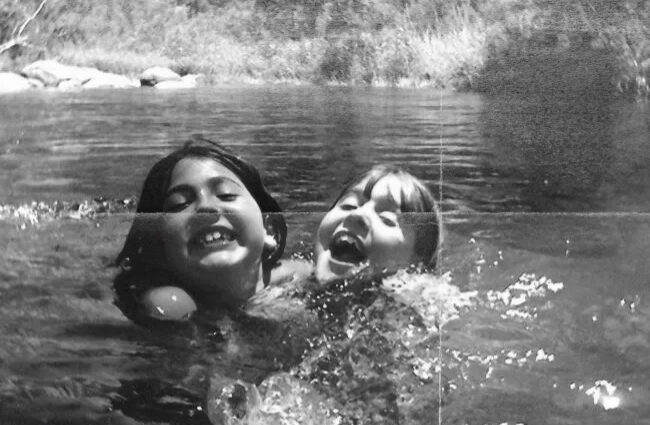
What more can you ask from childhood than a swimming hole?
Mine was in the Little River, a stone’s skip from my family’s rustic summer cabin in Elkmont, Tennessee, that became part of the Elkmont Historical District in 1994.
From the summers of the early 1970s to the summers of the early 1990s, my twin sister and I went down to the swimming hole every day. The walk from our cabin seemed long then; it doesn’t now. My mother made us wear our oldest, most ill-fitting, and least flattering clothes, our Elkmont clothes, try as we might to grow out of them with each passing year. I don’t recall ever bringing anything with me but a towel slung over my shoulder. Today, nearly five decades later, you’d be hard-pressed to see me going anywhere without at least keys, a phone, something to wet my whistle, and maybe a snack.
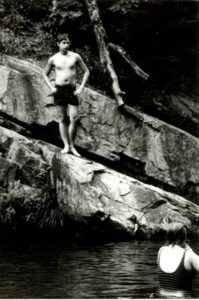
At the swimming hole, you never knew who you might run into, and we hoped to see a few friends from the dozens of other summer cabins perched dubiously on our wedge of mountain. In the 80s, when we were pre-teens, we most hoped to see the cute, curly-haired boys from Louisiana, forever shirtless. They liked to climb up the high, sharp slanting rocks on the far side of the swimming hole and dive in. A girl our age, much heartier than my sister and me, once tried to join them, but was screamed back down by her mom, hollering, “Who do you think you are, Richard Somers Creekmore Junior?!”
My sister and I were not at all hearty like [her]. We tended to cling to the large, smooth, mossy boulder on the near side of the swimming hole, where the freezing water was shallow and the critters were easier to spot. You only had to tell us once that there were water snakes about. Or that back on terra firma, there was quicksand to look out for. Swinging vines were eager to snap, and adorable bear cubs were sure to be followed by outraged mamas. You only had to tell us once, but our mother told us daily in place of “good morning” as she shooed us away to roam the wild until dark.
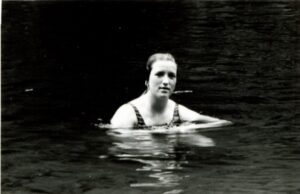
Early in the day at the swimming hole, we might see some dads sitting on the long stone bench on the narrow riverbank enjoying their Elkmont breakfast—a Schlitz and a Camel. Later, with the sun higher, you might see the older girls from up North laying out on the warm wooden dam in their two-pieces, rummaging their Elkmont purses—sandwich bags for lip gloss, hairbrushes and suntan oil.
If we hoped to see the cliff-diving boys we weren’t related to most, we hoped to see campers least (unfairly in hindsight). They cut through the swimming hole sometimes from the adjacent Elkmont Campground, today the biggest and most visited campground in Great Smoky Mountains National Park. There was a general distrust of the campers, adults who weren’t our parents, with big backpacks, metal walking sticks, and heavy boots. They appeared abruptly, a sudden encroachment from the fast-moving world on the other side of the bridge on the still summer space we feared losing. Our community was always under threat of demolition by the National Park Service, widely rumored for the purpose of expanding the campground. Even seeing a camper was quite the damper, a sinking reminder that we waded, swam, and dove on borrowed time.
The end came in 1992, when almost all of the summer families were evicted from our cabins and the land reverted to the Park. Evicted from the cabins and effectively the swimming hole. Without the summer families around to keep the swimming hole maintained, the path to it became overgrown. The long stone bench shifted and broke apart. Trees fell, impassable boulders piled up.
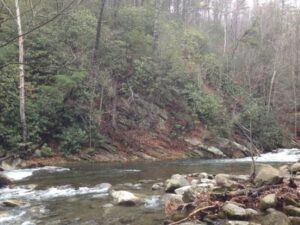
What’s left is largely our little secret. The swimming hole, a puddle now, is still there for those who know the way—or who to ask. The water isn’t deep enough for diving, swimming, or rock clinging; the old dam is washed away. There are arguably bigger and better swimming holes in the area like the Townsend Wye, but we choose our first love. We get there carefully. Only periodically. And just a few of us at a time. But we get there, and for a wisp of a moment, we see it as it was. The boys on the rockface. The girls on the dam. The twins on the boulder. For a wisp of a moment, we’re back.
Evelyn Creekmore spent 21 summers at her family cabin in Elkmont, Tennessee, which her ancestors built before the Great Smoky Mountains National Park was established. This private property was condemned by eminent domain before her aunt, Eleanor Creekmore Dickinson, led the charge to have the entire Elkmont community preserved through historical designation. Eleanor won the designation on paper, but in reality, the cabins were left to benign neglect for 25 years before maintenance began on what was left, and the historical district was opened to the general public. Read Evelyn’s book, Saving Elkmont, to learn more about this historic community in the heart of Appalachia, or sign up for more stories and updates by emailing yaeg4elkmont@gmail.com.
Read the following stories from Evelyn Creekmore published in Appalachia Bare: “Elkmont: Still Not an Abandoned Ghost Town” and her Honorable Mention entry entitled “The Other Pitty Pat” for our Folklore Short Story Contest 2025.
**Featured image from MorgueFile stock image site, altered BW, cropped, and adjusted