Last week, someone died. Actually, lots of people, if you add it up. Grandpa says a million people die every week, though it’s probably not a perfect number every time. Still, somebody gets to be the millionth now and again, only they wouldn’t know it. Not like the ten-thousandth customer or fiftieth caller who wins a prize.
What I mean is someone died who I knew personally. Then again, you can’t know people like you know lizard facts or different kinds of rocks. Rocks are better than people anyway if you know where to look. Over by the water pump, in the sinkhole, you can—ah, sorry, I get sidetracked talking about death. It’s like diving into a pool of all the things you try not to think about, like when and how and will it hurt and most of all why.
A million die, but two million are born, Grandpa says. Like ratios in math: two-to-one. Dad believes souls are eternal, but when I asked where all the new souls come from to make up the difference, he sent me to my room (even though I’m practically a teenager!). Maybe souls split in half to fill new babies. Then split again and again, two-to-one. Maybe that’s what’s wrong with everyone: just tiny bits of soul split between all of us.
So, Jeanine, the old lady next door, she died and somewhere two babies replaced her. She lived alone and was only sometimes nice. She never said anything horrible—she’d just look anywhere but at you. And by you, I mean me. Me specifically. She’d wave at the postal lady Millie every morning and at dad sometimes, so I know she could see. In fact, she was always watching. Always from her porch chair, fluffing her fat white cat, talk radio yapping through the screen door, two dozen yard angels, gnomes, and rabbits facing her like a music crowd.
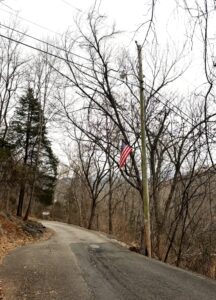
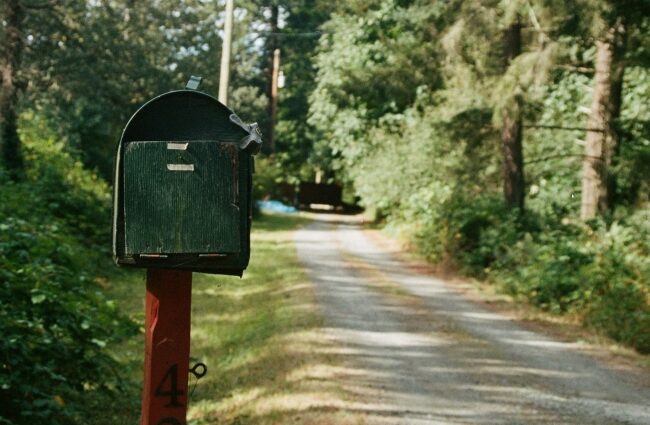
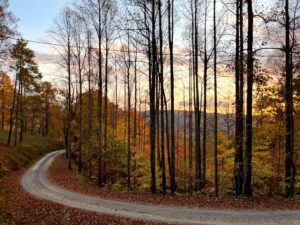
Her house is on the mountain too. We share a gravel road, this steep, twisty one-lane driveway in the woods so we have to drive a big SUV instead of a small car and the school bus wouldn’t even try. The neighborhood mailboxes are side-by-side at the bottom, eight or nine tucked under a little roof with a bird’s nest inside, the mama flapping in your face when you get too close. An American flag sticks out from the utility pole above it, but only halfway up so it doesn’t touch the wires. Half-mast, Grandpa says, like something bad has always just happened.
Now Jeanine was old-old, like a Q-tip in a bathrobe, all white on top and skinnier than bones. She shuffled slowly, like she might snap in half just minding her porch. She had no car and couldn’t walk down the hill, so that was it: just the rocky woods between our porches. Her daughter Jenny—she’s an old lady, too—dropped off groceries every Friday but didn’t stick around for dinner. As far as I know, Jeanine stayed on the hill and never went down.
So, Millie went on eternity leave and the new postal person didn’t bring Jeanine’s mail to her door, so Dad made me fetch it coming home from school. Worse, he made me walk down to get it on Saturdays too, like she was waiting on something important. She only thanked me the first time and she called me Mildred even though my name’s Grace. After that she’d just say anything good and I’d say no, only junk and she’d sigh really deep.
It drove me bonkers trying to figure out what she expected. One time, she got a card in a purple squarish envelope with little kid handwriting, addressed to Gramma. I said what about this, but she just tossed it into a wire basket right inside her door guarded by a wooden goose in overalls, shut the screen door in my face, and said she’d know good mail when she sees it. Well, I sure as schist couldn’t.

Then, out of the blue, she got all paranoid and barked at me to stop touching her mail, which ticked me off. She accused me of messing with stuff, but that’s ridiculous—I only messed with stuff at the bottom of the driveway where she couldn’t see me. I was careful too. I used a pocketknife to open and a glue stick to close. If I couldn’t get an envelope resealed just right, I’d crumple it and toss it way back in the woods where she’d never find it. Plus, it was all just coupons and catalogues and boring stuff from assurance companies. No idea why she got so suspicious. Trust issues, I bet.
After that, her daughter brought the mail in with the groceries, but still the mailbox was stuffed so full every week its mouth wouldn’t shut, and paper flew out whenever the bird flapped in your face. I guess that’s why Jeanine tried to go down the driveway, to get all that mail for herself. Dad found her on his way home from work, crumpled at the bottom of the driveway, feathers all around, paper strewn everywhere by the breeze, scattered like a soul. She still gets mail but someone else picks it up. Whoever does, I hope they know good mail when they see it.
Tim Becker (he, they) is an AuDHD musician, visual artist, and award-winning writing teacher and scholar from North Carolina. They hold an MA in English from NC State University and their work has been featured in Wordgathering: A Journal of Disability Poetry and Literature, Textshop Experiments, And/Both Magazine, Entropy, Composition Studies, and Composition Forum. Tim teaches writing at Virginia Tech and lives in Blacksburg, VA with their favorite geologist Naomi, a houseful of cats, and a formidably steep walk down to the mailbox.
**Featured image credit: Reid Naaykens, Unsplash, cropped
Really love this one. Moving and beautiful!