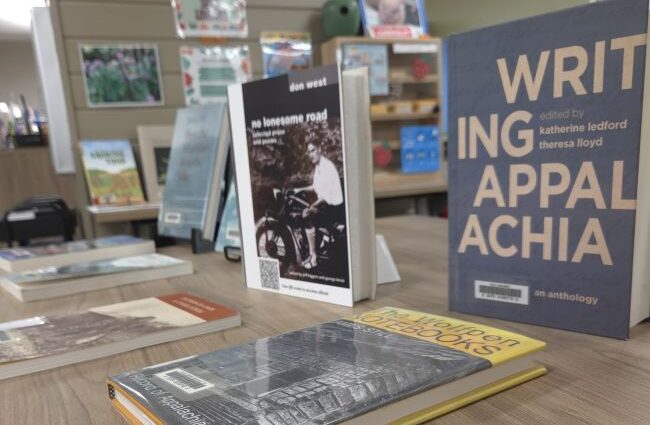
Appalachia Bare recently attended the 2026 James Agee Conference located at Pellissippi State Community College’s Strawberry Plains Campus in Knoxville, Tennessee. I would encourage any writer—especially those around the mountain region—to attend the James Agee Conference. Wonderful experience.
The 2026 James Agee Conference
James Agee (1909-1955) was a writer, screenwriter, and film critic who was born in Knoxville, Tennessee. His posthumously published novel A Death in the Family won the Pulitzer Prize for fiction in 1958.1)His paternal pedigree is located in Campbell County, Tennessee. You can find more information about the Agees in Delonda’s article “On the Other Side of Agee.” The James Agee Conference is a free one-day annual event that offers workshops from the hottest Appalachian writers. The conference is seasoned with recognition, information, and history about the region. This year, workshops were conducted (in order) by Patrick Wensink, Mark Powell, and James E. Cherry. Conference goers also heard emerging writer Grace Buckner read her stories “For Ethan” and “The Laurels.” The event also hosted the celebration of Pellissippi State Libraries’ first rare books and manuscript collection—a collection of none other than acclaimed Appalachian writer Jesse Stuart.
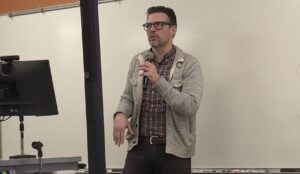 Patrick Wensink
Wensink’s workshop centered on creative nonfiction where he introduced participants to the CROW methodology, meaning “Character, Relationships, Objective, and Where/When happenings.” Creative nonfiction, he says, uses fictional techniques for effect. He focused on details, saying that “details help make it relatable.”
Patrick Wensink is the author of five books, including the bestseller, Broken Piano for President. NPR named his most recent novel, Fake Fruit Factory, one of the best books of 2015. His journalism appears in the New York Times, Esquire, Salon, Men’s Health, Oxford American and others. In 2017, HarperCollins published his first children’s book, Go! Go! Gorillas!. The sequel, Gorillas Go Bananas hit shelves in 2018. He teaches at Lincoln Memorial University in Tennessee and directs the Mountain Heritage Literary Festival.2)The bio provided is taken in large part from the biography of his website.
Click the following images to find Patrick Wensink’s books:



 Mark Powell
In his workshop, Mark Powell shared that “writing is an art, not a science.” He referenced T. S. Elliott’s “quasi-musical choices” and how one’s work sounds. While important, Powell said, writers should reach even wider to the “quasi-astronomical.” To do so, one must begin with what has emotional resonance. Further, Powell said the mechanics of writing can be viewed like a “scaffolding problem,” and writers must understand that everything in the scaffold has to be “load bearing,” meaning everything in a story must be there for a reason. He encouraged writers to just write instead of fixating so much on editing and perfection. “Don’t interrogate everything on the page you’ve written,” he imparted.
Mark Powell is the author of Prodigals, Blood Kin, The Dark Corner, The Sheltering, Small Treasons, Firebird, and Lioness. He has received fellowships from the National Endowment for the Arts, the Breadloaf and Sewanee Writers’ Conferences, and twice from the Fulbright Foundation to Slovakia and Romania. In 2009, he received the Chaffin Award for contributions to Appalachian literature. He has written about Southern culture and music for the Oxford American, the war in Ukraine for The Daily Beast, and his dog for Garden & Gun. He holds degrees from the Citadel, the University of South Carolina, and Yale Divinity School, and directs the creative writing program at Appalachian State University.3)The bio provided is taken in large part from the biography on Appalachian State University English Department site.
Click the following images to find Mark Powell’s books:


 James E. Cherry
Cherry’s poetry workshop focused on five elements that make a good poem: imagery, word economy, tension, density, and personal risk. He relayed that imagery is effectively built through standard metaphors, similes, etc. Word economy produces sharper imagery, while white space also becomes part of the poem. Tension can be implicit or explicit, and density offers complex and informational levels that are “snapshots in time.” The last of the five elements, personal risk, contemplates the questions, “What’s at stake? What is the poet risking to write the poem?” Regarding political risks, Cherry revealed that “All art is political to some degree.”
James E. Cherry is a poet, fiction writer, professor, literary activist and impresario. He is the author of four books of poetry, two novels, and a collection of short fiction. His latest novel, Edge of the Wind, was re-issued in 2022 from Stephen F. Austin University Press. His latest collection of poetry, Between Chance and Mercy, is forthcoming from Willow Books. He has been nominated for an NAACP Image Award, a Lillian Smith Book Award and a Next Generation Indie Book Award. His writings have been published in journals and anthologies in the U.S. and internationally.4)The bio provided is taken in large part from his website.
Click the following images to find James E. Cherry’s books:


Jesse Stuart Rare Books and Manuscripts Collection
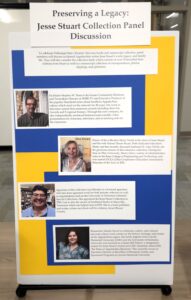
The conference hosted the Jesse Stuart Collection panel of four people who discussed Jesse Stuart’s writings, his writing relationships, and his family life:
Stephen W. Dean is the former Community Relations and Promotions Director for WBIR-TV and Executive Producer of the Heartland Series that highlights Southern Appalachian culture.
Marty North is the niece of Jesse Stuart and mother to the college dean, Dr. Mike North. She and “her recently deceased husband are the generous donors of this extensive collection.”
Lisa Misosky is a licensed appraiser and the owner of Southland Books in Maryville, Tennessee. She assessed the Jesse Stuart Collection in 2024.
Natalie Sweet is a historian, author, and James Still Fellow. Her work “centers on the history, heritage, and stories of the Appalachian region.”
Jesse Stuart was born in Appalachia’s Greenup County, Kentucky, to Mitchell and Martha Hilton Stuart. He was a prolific writer and distinguished author, a committed educator, world traveler, farmer, and an environmentalist.5)Info from the Jesse Stuart Foundation bio In 1954, he was elected Kentucky’s Poet Laureate.6)For more information about Jesse Stuart and other Appalachian authors, check out Ed Francisco’s article “Appalachia’s Sons: A Triptych of Talent.”
The panel discussed the fact that, despite their parents’ lack of education, Jesse Stuart and his adult siblings all received college degrees. Stuart had several interesting jobs in his youth, such as working for a carnival and joining the civilian military. He attended Lincoln Memorial University and Vanderbilt University, both located in Tennessee, though it was no easy task because he worked very hard to pay for his education. Stuart was among a group of writers—Don West, James Still, etc.—who went to college together and who remained close, yet extremely competitive with one another. A lot of encouragement, good natured ribbing, and critiquing ensued. One of Stuart’s greatest influences was founding member of the Fugitives and later of The Southern Agrarians, Donald Davidson.
Marty North, Jesse Stuart’s niece regaled the audience with memories of her larger-than-life uncle. “He was a big man,” she told the audience. She and her cousin Jane (Jesse’s daughter) often played together as children. She said Stuart “used an old smokehouse as his office,” which was understandably off limits. One day when they were very young, she and her cousin wandered into the smokehouse with crayons and drew on many of the papers located in the room, without knowing the papers were Stuart’s manuscript. Mind you, this is back in the day when you typed everything via typewriter. No “save” button and no “cloud” existed for typewriters, so I imagine a bunch of re-typing ensued. The collection is just stunning and we were so fortunate to have been witness to the celebration.
Gallery


Sitting: Jesse Stuart Panel (L to R) Collection Appraiser Lisa Misosky; Researcher and historian Natalie Sweet; Niece of Jesse Stuart Marty North; and former Executive Producer of The Heartland Series (WBIR) Stephen W. Dean


Thank you to the following:
- Pellissippi State Community College
- Dean of PSCC Strawberry Plains Campus, Mike North
- PSCC Strawberry Plains Campus Library
- The Appalachian Heritage Project
- Charles Dodd White
- Allison McKittrick
- The Jesse Stuart Collection panel
**All photographs were taken by Delonda Anderson
References
| ↑1 | His paternal pedigree is located in Campbell County, Tennessee. You can find more information about the Agees in Delonda’s article “On the Other Side of Agee.” |
|---|---|
| ↑2 | The bio provided is taken in large part from the biography of his website. |
| ↑3 | The bio provided is taken in large part from the biography on Appalachian State University English Department site. |
| ↑4 | The bio provided is taken in large part from his website. |
| ↑5 | Info from the Jesse Stuart Foundation bio |
| ↑6 | For more information about Jesse Stuart and other Appalachian authors, check out Ed Francisco’s article “Appalachia’s Sons: A Triptych of Talent.” |