
Sarah Moore Traylor’s senior yearbook at Maryville College in Maryville, Tennessee, was confident of her talent. “She can write,” The Chilhowean proclaimed, and I agree. That college talent was ultimately fulfilled in two novels: The Red Wind and its sequel The King’s Medallion.
These historical novels feature events of the mid-18th century frontier at the British-built Fort Loudoun, a thrilling story that includes an ambush, a massacre, and captivity by the Cherokee. The fort was located on the south bank of the Little Tennessee River near present day Vonore in Monroe County, Tennessee. In the 1750s, villages of the Overhill Cherokee, such as Chota, Tallassee, Citico, Tuskegee, and Chilhowee, dotted along the banks of the river. When the Little Tennessee River was to be dammed in the 1970s, the Tennessee Valley Authority reconstructed the fort on higher ground and did an archeological study of the areas that would be flooded. The land is now a state park.
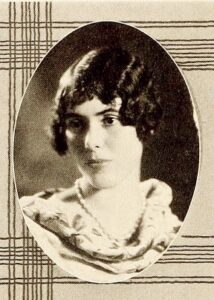
Sarah Lucille Moore was born in Georgia in 1908 to Percy W. Moore and Vannie Hunt Moore. She wrote her first story at age 8. In 1918, her family moved to Alcoa, Blount County, Tennessee, where her father had a job with ALCOA Aluminum Company. She grew up with four brothers and two sisters. In 1925, she entered Maryville College and was thrilled to have one of her themes in freshman composition read to the class by her professor. She graduated in 1929. While in college, she participated in several activities that previewed lifelong interests: debate, drama (as an actress and a playwright), editor and features writer for the college newspaper (The Highland Echo), and Writers’ Work Shop (for upper class students who excelled as writers.) In addition to literature, history was one of her favorite subjects.
The feature articles that Moore wrote for The Highland Echo reveal creativity, a sense of humor, and the ability to create a character. Topics of her features include an interview with a Korean student, a humorous look at play rehearsal, a satirical argument opposing New Year’s resolutions, a comparison of Maryville College’s final exams with Harvard’s, and an amusing interview with a typical co-ed, dubbed “Miss Maryville,” about a date she’d gone on and what she wore. What with writing for the newspaper and assignments for the Writers’ Work Shop, Moore had the opportunity to develop the self-discipline a writer needs and confidence in her skills.
After graduation, she taught in the Alcoa school system. In 1930, she married George Hamilton Traylor, an engineer originally from Georgia, who worked at ALCOA Aluminum. They had three children. Through the years of raising her children, she was involved in their schools and activities, teaching in her church and supporting its programs, and aiding Maryville College as an alumna. Her husband’s career with ALCOA included much travel. She accompanied him to Mexico, Australia, Taiwan, Trinidad, and Norway.
Sarah Moore Traylor was a lifelong learner. In a biographical sketch, she said she read anything and everything. She also took continuing education courses at Maryville College in Cherokee culture, Appalachian Studies, and Creative Writing. Her two novels and other writing bear witness to her careful and detailed research.
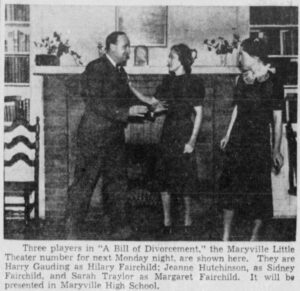
Throughout her busy life, the desire to write kept calling. Traylor took advantage of projects that interested her. She wrote three plays on historical topics. In 1939, her one-act play “In Her Defense” was published in Tested One Act Plays.
In it Andrew and Rachel Jackson confront the scandal of Rachel’s first marriage. Another one-act play, “Some Must Die,” the story of Fort Loudoun, won a state competition in 1941 and was produced. From this time forward, she returned to the subject several times. In 1980, Traylor wrote “Give Us the Wind,” which dramatized Cherokee history and was produced by Maryville College with partial funding from the Tennessee Committee for the Humanities. It was also presented in 1984 as part of Blount County’s Dogwood Arts Festival. She portrayed another local subject in A Goodly Heritage: A Historical Pageant, a history of New Providence Presbyterian Church in Maryville. It was commissioned and presented in 1954. Traylor’s work in these dramas allowed her to hone her skills in dialogue and character.
In the 1950s Traylor joined the Board of Directors of the Fort Loudoun Association. Her research turned to further exploring the colonial history of East Tennessee and South Carolina as well as Cherokee history and culture. Some of her research was done in London and Edinburgh. Eventually, having lived with the history of the fort for many years, she decided to write a novel about Fort Loudoun and the dramatic events that led to the massacre.
The frontier fort was occupied by the British from 1756 to 1760. It was the first British fort in what would be the state of Tennessee and the first British fort west of the Appalachian Mountains. Fort Loudoun played a small part in the French and Indian War (known in Europe as the Seven Years’ War between the British and the French.) The British and French were vying for supremacy in the land between the Appalachian Mountains and the Mississippi River. To that end, each nation tried to make allies of the Native American tribes in the region and to prevent the other from taking possession of the land. The Cherokee were divided as to which country to support.
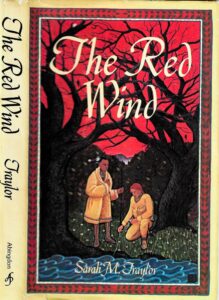
The Red Wind, published in 1977, charts the course of young Angus Ferguson, a Scots immigrant to the colony of South Carolina. Angus narrates the story. The title refers to the Cherokee description of the wind from the east, a red wind which brings war.
On his voyage from Glasgow to Charles Town (Charleston) in the colony of South Carolina, Angus witnesses men and women being thrown overboard from a slave ship. He reports this to the authorities in Charles Town when he arrives, but his testimony creates powerful enemies against him, and an attempt is made on his life. For his own safety, friends encourage him to join an expedition to Fort Loudoun over the mountains from South Carolina. On the way there and at the fort, Angus makes new friends: Abram, a slave: Tsalohi, a young Cherokee man, and his sister; and Mistress Bacon, who runs the trading post for the fort. Angus acts as clerk to the trading post and for the two British officers, Captain Stuart and Captain Demere. Tensions rise between the Cherokee and the British as the royal governor and military leaders in South Carolina make several missteps. Their actions push the Cherokees to turn from allies to enemies and to decide that they no longer support a British fort among their settlements. Eventually the Cherokees besiege Fort Loudoun. As supplies dwindle, Captain Demere, the chief officer, has to deal with disgruntled soldiers, deserters, and a near mutiny. Angus, as clerk to the captain, follows the deteriorating negotiations with the Cherokee and Demere’s narrowing choices for the garrison. Although the British hold out as long as possible, they are finally forced to abandon the fort and to ask the Cherokees for safe passage back across the mountains to Charles Town. Their request is granted. But not all of the Cherokees are satisfied to let the British go so easily. Some demand vengeance for the killing of twenty-four Cherokees taken as hostages by the British. On the trail, near present day Tellico Plains, Tennessee, the British are ambushed. Many are killed, others are taken captive, some of who will meet awful fates in retribution for the executions of the Cherokee hostages.
Angus’s friendship with Tsalohi and his sister Ahwinita is a small reflection of the larger situation between the British and the Cherokee. At first they are friends. Tsalohi takes Angus on a deer hunt and later shows him how to throw a hatchet. In thanks for this, Angus gives Tsalohi a hunting knife. But the stress of the unravelling alliance between their peoples frays their friendship also. Each one is loyal to his people. In the massacre on the trail, Angus and Tsalohi come face to face when Angus is wounded: “[Tsalohi’s] dark eyes glared into mine . . . . Amid the yells and screams and shots we were silent, frozen antagonists.” But Tsalohi hesitates and spares Angus to be taken captive. Angus witnesses the horrible revenge taken on Demere and twenty-four captives, but fortunately his life is redeemed.
A strength of the novel is Traylor’s ability to show the differing perspectives of the Cherokee, using historical characters, such as Attakullakulla, who favors peace; the more warlike Oconostota; Nanye-hi, who will become known as Nancy Ward, the Beloved Woman, who tries to maintain peace. The complex relations between Cherokee and British sadly foreshadow many clashes to come as the British, and later the Americans, pour over the Appalachian Mountains through Native American lands.
Advertised by the publisher as a young adult novel, The Red Wind received two enthusiastic notices in The Knoxville News-Sentinel when it was published. Wilma Dykeman, author of The Tall Woman, states the theme of the novel: “each individual must be judged on his and her own merit, each event must be understood in the context of its times.” She praises Traylor’s re-creation of the atmosphere of 18th century Charleston and the Overhill Cherokee communities. Similarly, Carson Brewer, a columnist for the News-Sentinel who often focused on local history, enjoyed the novel’s skillful mix of history and fiction to tell the tragic story. Like Dykeman, he thought that the novel would appeal to adults as well as to young people. The approval of these two writers is high praise.
In 1984, Traylor continued Angus’s story in The King’s Medallion, which begins in 1760 shortly after the events in The Red Wind. The medallion refers to those given by King George II to Attakullakulla and six other Cherokee leaders who visited England.
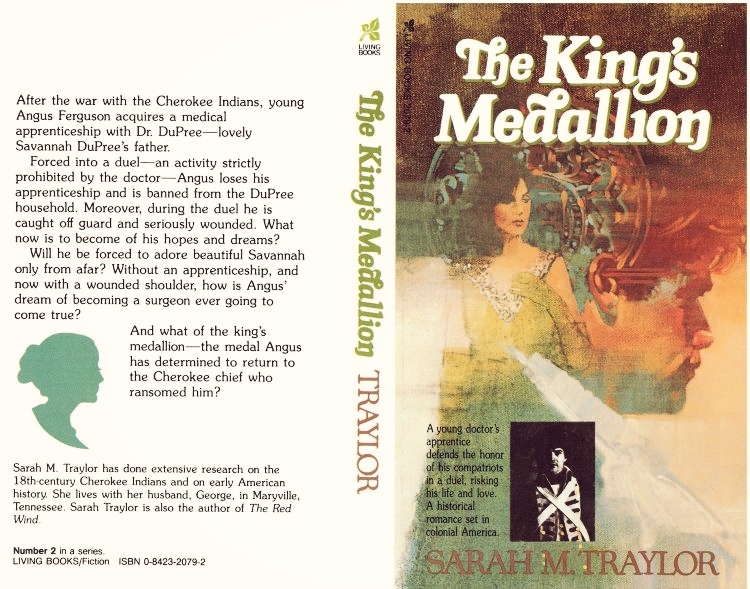
In contrast to the plot of The Red Wind, which closely follows historical events, the plot of The King’s Medallion is structured more around Angus’s experiences and choices as he decides to study medicine. He apprentices with Dr. DuPree, who befriended him when he was first in Charles Town. Among his medical studies are experiences inspecting the pest house and the jail, combating a typhus outbreak, and learning about Cherokee methods of healing. His personal experiences include a romance with Savannah DuPree, the doctor’s daughter; fighting a duel; and surviving a hurricane. He meets wealthy, influential men in the colony as well as slaves and prisoners. At one point, Angus joins an expedition to the Cherokee settlements along the Little Tennessee to ransom a captive. He witnesses the Cherokee ceremonies with their beautiful clothing and dancing. Meanwhile, in the background of the story, conflicts between the colonists and royal representatives foreshadow the revolution to come a few years later.
The name “Savannah DuPree” has a special significance for Traylor. It belonged to her great-grandmother, who was from South Carolina and lived through the Civil War. This is a delightful personal connection! The fictional Savannah is high-spirited, independent, and kind, a worthy tribute to the real Savannah.
The ending of The King’s Medallion points to a sequel. When Traylor visited one of my classes when I taught at Hiwassee College, she said that she planned a third novel to recount Angus Ferguson’s journey to Edinburgh to further study medicine. Unfortunately, she was not able to complete this book.
In a 1993 article in The Knoxville News-Sentinel, Traylor is quoted as saying that she never thought she’d write a book. What is clear is that throughout her life, although she often listed her occupation as “housewife,” the creative impulse never deserted her. Her dedication to her craft finally came to fruition in a pair of novels. Fittingly, Maryville College honored her as an outstanding alumna in 1984. She was lauded as an author, playwright, and lecturer, thus fulfilling the expectations written by The Chilhowean.
Sadly both The Red Wind and The King’s Medallion are out of print. You may find an old copy in a library. If you search used book sites online, you will occasionally come across The Red Wind in hardback or paperback. The second novel was published only in paperback and is harder to find.
I hope that a publisher will take an interest in reprinting these two novels or in creating e-books. They are among the few novels to cover this 18th century period of East Tennessee history. They are appealing, well-written, and deserve to be read.
A native of East Tennessee, Carol J. Luther has published work in Still: The Journal, in Persimmon Tree, in Broad River Review, in Teach.Write., in Flying South, and elsewhere. She is Professor Emerita at Pellissippi State Community College in Knoxville, TN, where she taught literature, composition, and film studies. Through the study abroad program at the college, she taught courses in France, Ireland, and Japan for students from across Tennessee.
Special thanks to the following for assisting me in researching Sarah M. Traylor’s life and works: Amy Lundell, Maryville College archivist; Stephanie Gillespie, reference librarian, Pellissippi State Community College, Knoxville; Melinda Rust and other reference librarians at Blount County Public Library.
**Featured image credit: Patrick Fore, Unsplash. Image of Sarah Traylor from The Chilhowean, 1928—provided by Carol Luther, added here by Delonda Anderson.