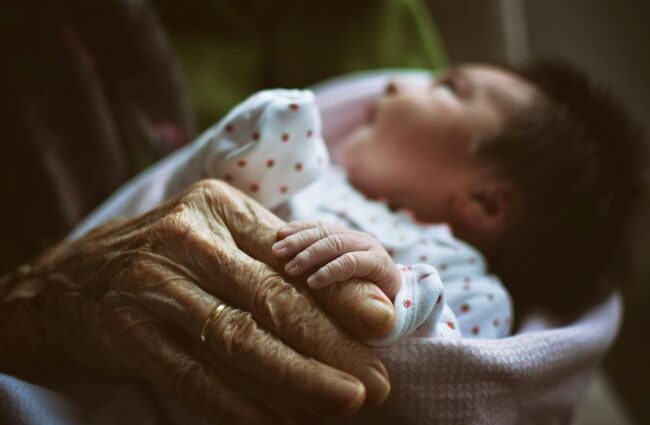
Grandmothers are a bedrock of Appalachian lore. Our Mamaws, Mammaws, Mawmaws, Meemaws, Grans, Gran-Grans, and Grannies invade our tales as smart, funny, and compassionate matriarchs who shape our definitions of love, fortitude, and resilience during our formative years. Their towering presence in our youth calls attention to the all too often absent parents in our lives. Yet, their folksy wit does an admirable job diverting attention from the painful reality of being raised in a single parent household. This trait—retaining a sense of humor through dreadful circumstances—is the subtext to all lessons.

Maybe one of the most integral traits passed down by our grandmothers is their resilience. Again, central to the culture of the region, it was our grandmothers who taught us how to get back up after innumerable stumbles. In my case, and I’m sure many others, my grandmother frequently demanded I demonstrate my grit no matter how grim the outcome of doing so. Resilience is so deeply embedded in our oft-idyllic memories of our grandmothers that, as we age, our memories of them become our roadmaps for resistance. Shared through story on front porches across the region, these extolled memoirs help us understand how to persist.
Yet, despite these grandiose depictions, we often acknowledge the complicated nature of returning home. Appalachian literature is rife with homecoming stories and the complex emotional realities of the returned protagonist. The people we associate with home, often taught the same lessons by the same grandmothers, sometimes seem to internalize and externalize these teachings in such a disparate way that we start to feel like outsiders in the places we grew up revering. Returning to my grandmother’s house nearly always causes me to feel the emotional heft of this paradox.
Though Granny’s house was long ago scarred by a fire, and only the concrete slab of the front porch remains recognizable, I still make an effort to pay my respects whenever I am nearby. I wander the burnt out shell with the reverence many reserve for houses of worship, cemeteries, and monuments erected to preserve history. Solemnly, I shuffle my feet through the debris of her old row home tucked away in the coal country trying to make the space feel alive again. I inhale deeply as I step off the porch through the threshold of the front door, seeing if my nose can detect the unique blend of mothballs, Pall Mall Reds, and stale whiskey that pervades the memories of my youth.

Gradually, I kick my way through the house as the rubble crunches under my feet. I pause in the kitchen. Granny always called it the home’s heart and soul. Standing there amidst the charred debris I can vividly recall the room as it was in my youth. Walls yellowed from the chain smoking, a small wooden table with two mismatched chairs, bright green countertops with an emergency bottle of Irish whiskey poorly hidden in the cabinets should guests work their way through the main stash atop the counter. I pause and examine the small square of land where the kitchen table would have been. If I stare long enough I can picture a book, undoubtedly about a prominent figure in a labor movement, resting on the table next to my grandmother’s omnipresent cup of tea.
As I recall the white mug filled with Lipton tea, the juice of a quarter of a lemon, a spoonful of honey, and a dash of whiskey if it was past five, I can see my grandmother’s gnarled, arthritic, fingers swirling the spoon. The memory of her aged hands ignites something in me and suddenly the space is alive again. I can feel the presence of my aunts, uncles, cousins, and their friends. The conversation is loud, passionate, and swirling.
At her dinner table, my grandmother always insisted, there were a few rules about conversation that must be followed. First rule, we talked about politics and religion. If someone is telling you that a topic is off limits, there is great power in confronting the topic head-on. Second rule, we believed in organized labor and collective bargaining. The labor unions were our only hope against the tyranny of coal companies and nothing we did or said in our public or private lives would undermine their already-diminished power. With this in mind, spirited political discussion was welcome, but guests who did not understand the life and death struggle of union support were cautioned to tread lightly. Finally, at her dinner table, denigration of the Catholic church was forbidden, and if the clergy decided to pay a visit, they took your seat and your plate without question.
The first smile of the trip slowly unfolds across my face as I recall the consequences of violating the third rule. As a frequent skeptic of organized religion’s wares, and one who was never willing to part with Granny’s cooking, I was well acquainted with the knuckles on the back of her right hand for my disobedience. A strange memory to hold dear, but it causes me to remember her love—as fierce as her discipline. The imposing figure my grandmother cut always belied her loving nature.
Steely enough to fearlessly walk picket lines with a snub nose pistol strapped to her ankle, compassionate enough to keep her front door unlocked, a sheet on her couch, and a bassinet next to it, always available via word-of-mouth to women and children fleeing domestic violence for an evening or more. When the opiate crisis was in full swing and property crime spiked in her town, I remember asking if she started locking her front door. Seemingly offended by the notion that she would be scared away from supporting the most vulnerable in her community, she raised her voice and let out her trademark phrase, “Glory be to God, Michael! What does the church teach us? If anyone needs it bad enough to break into my house, they need it worse than me. We’ll all be made whole again.”
I frequently wonder what my grandmother’s house would be like if she was alive today. Fearing how the machinations of time would disturb my anachronistic memories, a part of me is secretly relieved the house has been reduced to a pile of rubble. Though I passionately believe trying to resurrect the dead to analyze their beliefs is a wholly fruitless endeavor, the beliefs of her children, and their children, are revealing. Largely secular, anti-union, and, in many cases, ardently organizing to Make America Great Again, my grandmother’s flock seems to have strayed from her teachings. Rather than amplifying her messages of acceptance and love, of community and selflessness, I can’t help but feel that many in my family have perverted the lessons she bestowed upon us to justify belief in a regressive ideology.

My family has so fervently strayed from what I believe my grandmother taught me that I sometimes wonder if I failed to comprehend her lessons. While I have no issue with the pistol affixed to my enduring images of Granny, I largely consider myself a secular, liberal Democrat. In opposition to the church, I believe in a woman’s right to seek an abortion, the person I feel safest leaving my kids with when I need a babysitter is my neighbor who is trans, and I have marched in protest to demonstrate solidarity when Freddie Gray, Michael Brown, and George Floyd were murdered. While, in many ways, my actions largely make me the black sheep of the family, their stubborn love for me is the genesis of my omnipresent optimism. The resilience of their love for their radicalized leftist cousin is my reminder that we are not as divided as some may want us to believe.
When the visit to Granny’s house concludes, I load my family into the car and swiftly traverse the windy roads of the Appalachian Mountains to my cousin’s home. Inevitably, word has traveled that I made an appearance in town, and my family waits to jeer me for thinking I could get into, or out of, their corner of the world without them being made aware. My Uncle Chris pulls me in for a hug and whispers,
“An ant can’t fart in this fuckin’ town wit’ out me hearin’ about it, nephew. The fuck did you think you were gettin’ out of here without me gettin’ my paws on ya?”
His hug squeezes the air out of my lungs, and I remember how tightly my family holds onto their own. My cousin, Katie, in her thick accent, expresses her pleasure at meeting my kids,
“Ah, look at these little beauts, Mickey. Fiona and Zoey, Irish names? Not saint’s names? Didja think we wouldn’t notice? Glory be to God youse have Gran spinnin’ in her grave right now.”
She’s joking, but the weight of her words lingers. A reminder that my family’s love is real, but some distance between us remains.
Despite having, at best, a few hours’ notice, every living relative on my dad’s side fills my cousin’s house and all my favorite food is present. Walking into the house smells like walking into a field of garlic: city chicken, blind pigeons, corn fritters, bleenies, kielbasa, all ready to be washed down with a glass of boilo. The night goes on, seemingly forever. We stay far past our intended departure time, as I sheepishly glance at my wife, Erica, when my cousin offers a bed for the kids to sleep on, knowing we are staying. As I get up to put my kids to bed, Katie puts her hand on my shoulder.
“You and Erica keep talkin’, cousin. It’s nice gettin’ to know her and it’s been too long since we seen ya. I’ll put the babes down.”
I can see the reticence in Erica’s eyes. Fear that our kids won’t fall into slumber at the hand of a veritable stranger. Knowing how many times Katie helped a younger version of me fall asleep when I was scared, lonely, sad, or otherwise in a fragile place, I assure Erica her fear is misplaced. As they go back to their room for the evening, Erica and I stay at the kitchen table munching on pretzels and listening to my cousin, Patrick, regale us with stories. As the night winds down, I realize that in this crowded kitchen surrounded by family and old memories, we’re not just sharing stories or food. Rather, we’re passing down the resilient love that has bound us for generations.
Those who practice politics that are more consistent with my own often talk about finding salvation for people like my family. We must convince them to change their voting habits, stop voting against their own interests. We must help them understand that, as the world has changed, their very identities have become political. Their minds have been co-opted by the mirage of culture wars, merely intended to distract from the class warfare that is being perpetuated. If we can just convince them to vote Democrat, I am promised, they will be saved.
Media, hell, even our allies in the media, have espoused these problematic views of salvation. In an effort to preserve their liberal bona fides with the hope of being seen as acceptably mainstream, a number of publications based in Appalachia have run pieces where the author’s primary goal seems to be to remind everyone that it’s an acceptable practice to patronize the people who raised you. The search for acceptance, their hope of seeing their name in a highfalutin publication, clouds the teachings of their grandmothers. The pieces usually sound something like, “I know the people I grew up with are backwards hillbillies, but I think they’re worth saving anyway.”
This sentence, and its innumerable permutations, always evoke complicated emotions within me. The ahistorical analysis is the initial, if not somewhat minor, irritant. Buzzing around like a gnat, I wonder how so many can forget that a number of Appalachian states were reliably blue until recently. Similar to Granny, the region’s devotion to the power of collective bargaining in the face of titanic extractive industries paints a more nuanced political picture than many seem to realize.

Put another way, as it slowly became less profitable to tear natural resources from the hillsides that blanket the region, Appalachians turned to the ballot box and considered a number of federal, state, and local options. We voted Democrat. We voted Republican. We voted for any party that promised a better future. While we knew our chances were bleak, while we knew that our best hope resided in the ingenuity, passion, and love of our own, the Purdue trials turned our skepticism to cynicism. As we watched our loved ones be imprisoned for the addiction foisted upon our communities, the predatory family that made billions off our vulnerability successfully evaded the same fate regardless of which party controlled the Department of Justice.
Beyond the voting habits of Appalachians, sometimes I wonder how we arrived at a place in American political discourse where we casually discuss the salvation of the people we love, and wed their eternal placement in the spiritual realm to their political leanings. I wonder if the people that espouse this type of rhetoric had grandmothers who harbored a pathological devotion to defending the vulnerable. I wonder if they remember the lessons passed down by their grandmothers.
When I get done being angry and start thinking constructively, I wonder what it would sound like if we imbued our writing about our disagreements with love instead of paternalism. What if we shifted from using but to using and? What if we all promised to never write the word “anyway”? What if we said, “Our politics may differ these days, and I love them.” I wonder what embracing vulnerability sounds like. I, too, have been angry, self-destructive, lost and wandering in the dark. Those whose salvation we question shepherded me through those times, and they remain those same people today. They do not need the fictitious salvation offered by insincere political columnists searching for acceptance. Because the love my grandmother instilled in all of us is resilient, and beyond capable of trumping the divisiveness imposed upon us by distal politicians. It is up to us to demonstrate the reverence our canon heaps on our grandmothers is deserved.
In my most mind-wandering, internal monologue heavy moments, I wonder what it would be like to merge the two worlds I occupy. The liberal and the conservative. The rural and the urban. The hopelessly romantic and justifiably cynical. As I engage this fantasy, I realize my grandmother’s spirit still lingers. The love and resilience passed down by Granny, and the countless grandmothers like her, offers a deeper salvation than politics ever could. It is through their wisdom, humor, and fortitude that we navigate the complexities of life. Their legacy reminds us that even amid ideological differences, our connections remain strong. By honoring the lessons of our grandmothers and embracing the power of love over division, we demonstrate that the reverence we hold for them is not only justified, but essential for our collective survival.
Michael is a father to two girls, a husband, and a passionate gardener. When he’s not playing raucous games of hide and seek or tending to his plants, he works as a social worker who strives to imbue his work with empathy and compassion. Deeply connected to his roots as an Appalachian, Michael is currently pursuing a doctorate at Virginia Tech’s School of Education. Here he studies the intersection of child welfare agencies and schools, hoping to enhance the educational experiences of children in foster care.
**Featured image credit: Pedro Kummel, Unsplash