In the last thirty-six years, I have written seven books focused on the Sale Creek and Coulterville areas of southeast Tennessee. I have also contributed numerous articles to periodicals, school groups, and historical associations on the history of this area. Furthermore, I created two maps depicting local historical and geographical sites, along with two historical calendars. While I have explored many topics of interest to regional history enthusiasts, one subject always eluded me yet captivated my curiosity more than any other—namely, Camp Sale Creek, a German POW camp opened at the close of World War II. This camp temporarily housed 247 German prisoners of war, who were brought here in the summer of 1945 to assist in picking peaches for Hamilton Orchards.
In 1989, I searched for written documentation about the camp while writing my first book, Sale Creek, Tennessee – 1885-1955. Growing up, I heard stories about the camp from my parents, grandparents, and other locals. However, it wasn’t until I penned that book that I developed an interest in learning more about it.
At the suggestion of U.S. Army Col. Edward Alexander, I contacted the U.S. Army Military History Institute at Carlisle Barracks in Pennsylvania to request information about the camp or possibly pictures. Two weeks later, I received a letter stating that there was no record of a camp at Sale Creek and, therefore, no file photos were available. Finding no success there, I turned to personal recollections of surviving community members who had vivid memories of the camp.
Front cover
As I discovered at that time, there are advantages and disadvantages to relying on personal recollections of historical events. Personal feelings, experiences, and reactions are usually accurate and factual; however, the dates may not be. Based on interviews with those individuals, I initially established 1944 as the year the POW camp existed; however, after locating a newspaper article and a book about the camp, I discovered that the year was 1945 and that the camp existed after the European war had ended. The newspaper article, from the Chattanooga Times and dated July 23, 1945, was written by staff reporter Vivian Browne. The book that mentions Camp Sale Creek by name is Axis Prisoners of War in Tennessee, written by Austin Peay State University professor Dr. Antonio Thompson. This discovery of these documented works concluded my 34-year search for recorded camp information.
This narrative explores various aspects of the POW camp, providing a unique compilation of historical facts associated with the camp that have not been previously reported. Anyone interested in the town’s history and learning about the camp’s existence will appreciate knowing about Camp Sale Creek. I will draw from information in the article, the book, and the interviews I conducted with Sale Creek residents in 1990 when I wrote A Sentimental Journey Down Country Roads, as well as from a later book I authored in 1992 entitled When Peaches Were King.
Factors Leading Up to the Request for Prisoners to Come to Sale Creek.
Sale Creek was a major regional peach producer from the early 1900s until 1946. By 1926, Sale Creek had over 266,000 producing peach trees, covering most available and accessible hills. The business had grown in size, with buyers and shippers flocking to the community each year to obtain their share of the peach crop. That year, over 600 refrigerated boxcar loads of peaches, each carrying 384 bushels, were shipped to Dayton, Cincinnati, Lima, and Cleveland, Ohio; Wheeling, West Virginia; Detroit, Michigan; Pittsburgh, Pennsylvania; and Buffalo, New York.
In addition to buyers and shippers, other industry representatives gathered at the packing houses. These included representatives from chemical companies, railroad employees and agents, ice company agents, pump and spray manufacturers, and mule and horse breeders. The community buzzed with activity, especially during the peach preparation, picking, and packing seasons when the two packing houses routinely loaded fifty or more refrigerated boxcars of fruit each day. A veteran of that era who supervised the loading and shipping of boxcars once stated that the most railcars he ever saw shipped in a single day were 101, which amounted to 38,784 bushels. That is the unofficial one-day record.
When Times reporter Vivian Browne arrived in Sale Creek to report on the German POWs and capture the activity surrounding what promised to be a record crop, possibly as high as 250,000 bushels, she observed a diverse crowd of people gathered around the two packing houses. That group included college professors, farm extension personnel, high school boys and girls signing up for work, farm workers, writers, photographers, executives from food store chains, Army personnel, TVA observers, and customers seeking to buy quantities of sweet fruit.
Peach preparation began in late winter and early spring with pruning, dusting, and spraying. As the last owner of the Ell-Dee Orchard Company, William C. List, once told me, “The secret to raising good peaches is spray, spray, spray.” Other preparations included repairing the haul roads, getting machinery and wagons ready, and scheduling employees.
The picking process began around the third week of July and extended into early August. The Elberta peach came in first, followed by other less popular varieties, with the Brackett peach being the main late peach. Hooper Hyder, one of the last peach growers in Sale Creek, explained that all peaches are judged early or late compared to the Elberta, which is the standard. If a peach ripens before the Elberta, it is an early peach. If it ripens after the Elberta, it is a late peach. The Elberta variety was the most popular among the area orchardists.
The economic challenges caused by the Great Depression, the reluctance of area banks to lend money for the increasingly risky peach business, and several consecutive years of poor crops prompted some small operators to abandon the peach-growing industry. However, the two most prominent local companies, the Ell-Dee Orchard Company, owned by W.H. List and T.E. Downey, and Hamilton Orchards, belonging to Grover C. Eldridge, embraced the challenge and continued the enterprise.
With the onset of World War II in December 1941, numerous local men joined the military, resulting in the loss of approximately 387 workers from the local labor force. Additionally, many individuals who typically worked in agriculture sought more lucrative positions in defense plants and left farming for good. By 1945, the departure of orchard workers had led to a significant labor shortage for the two primary companies.
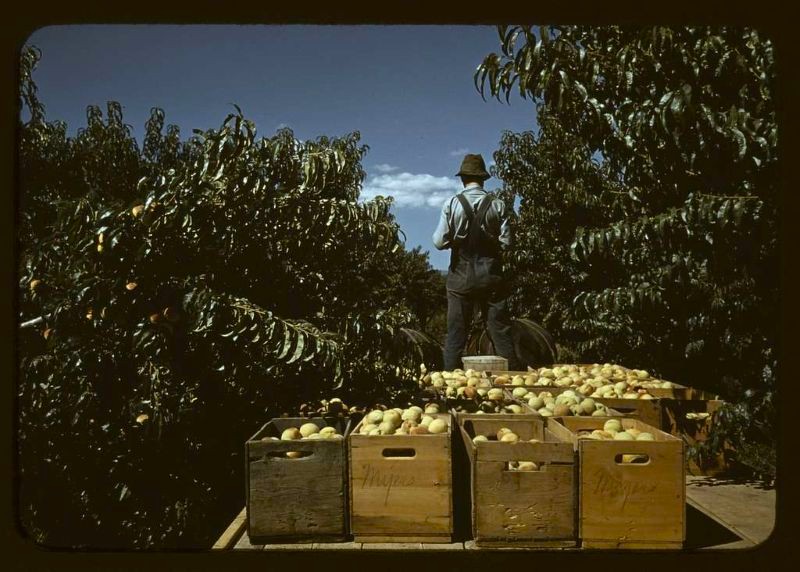
1944 Crates of peaches for hauling, U.S. Office of War Information, Russell Lee Collection for Farm Security Admin. – Picryl via LOC, no copyright restrictions
In 1926 and 1931, Sale Creek’s peach production peaked at nearly a quarter of a million bushels, but it later declined as many orchardists chose to leave the business. Despite the drop in quantity, the quality of the peaches improved markedly, enabling orchardists to fetch higher prices for the fruit. By 1944, the peach crop totaled only 50,000 bushels, yet it still yielded substantial profits for growers. However, projections for the 1945 harvest anticipated a bountiful yield reminiscent of the prosperous years of the 1920s and early 1930s. Grover Eldridge initially estimated a harvest between 150,000 and 250,000 bushels. To illustrate, at 384 bushels per railcar, the harvest would require over 651 boxcars for transport. If stacked end to end, those baskets would stretch more than 71 miles from Sale Creek to Knoxville, Tennessee. Peach farming constituted a vital part of local business, and there was genuine worry about potential financial losses for the community if a labor shortage hindered the timely picking and shipping of the crop. Furthermore, there was concern regarding the spring weather—the lack of late frosts would cause the fruit to ripen early, potentially a week ahead of the usual schedule.
Concerned about the situation, Grover Eldridge, owner of Hamilton Orchards on Lee Pike, drove to Fort Oglethorpe, Georgia, which housed a large number of German prisoners of war (POWs). There, he met with the base commander, Colonel Howard Clark, to discuss the possibility of sending some prisoners to Sale Creek to harvest his peach crop. Prisoners were used in agriculture across Tennessee to pick various crops, including strawberries, peaches, apples, peanuts, and potatoes. Eldridge emphasized the urgent need for these prisoners to gather the harvest, warning that the Sale Creek area could suffer significant economic damage otherwise.
During the war, over 425,000 Axis prisoners of war were held in the United States, with 378,156 being German and the rest Italian. Tennessee housed more than 8,000 of these prisoners, with the largest group located at Camp Forrest in Tullahoma, which is now part of the Arnold Engineering Development Complex for the United States Air Force.
Eldridge and the Army reached a two-fold agreement.
The first group of forty POWs arrived in early 1945 and began pruning trees and spraying. A follow-up group of 247 prisoners from Camp Forrest in Tullahoma arrived in mid-July to pick the peaches and load them into refrigerated boxcars.
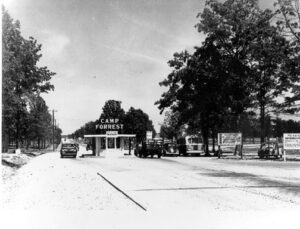
Camp Forrest in Tullahoma, Tennessee, was once an Army training base that was made into a POW camp during WWII – Tennessee Virtual Archive, copyright not evaluated
Georgia Rosenberg Eldridge, wife of Grover and of German ancestry herself, told the Chattanooga Times reporter, “The forty who had been here all along seemed just heartbroken when they were sent to another place [before the harvest]. They had worked on the peaches for months, spraying, dusting, and thinning. They had shown interest in their work and wanted to see how the peaches turned out. We’ve never had better workers.”
Neither the book nor the article explained where this group of forty prisoners camped while in Sale Creek; however, they were most likely housed at Grover’s farm on North Lee Pike, near Brown’s Bridge, as the large compound had not yet been built. Eldridge was known to have a building on his Lee Pike farm that accommodated some of his workers.
In 1990, when several elderly community members were asked about the number of prisoners in Sale Creek, their responses varied. Some estimated that there were only 25 to 30 inmates in total, likely referencing the initial group of forty that arrived and remained through the spring and early summer. Others indicated that at least eighteen eight-man tents were present in the prison compound. To accommodate this group of 247, a minimum of thirty-one tents would have been necessary, along with extra tents for cooking and other activities.
The Main Body of Prisoners Arrives.
Prisoners of war were expected to carry out tasks assigned to them by the War Manpower Commission. This commission certified the need for labor and determined the number of prisoners required for a specific project. In the case of the Sale Creek camp, the commission agreed that 200 to 250 prisoners were necessary to pick Eldridge’s peaches. Many prisoners were not particularly fond of agricultural work but chose it over remaining inactive in the main prison camps.
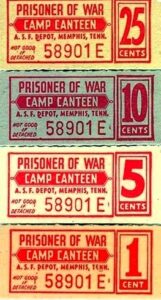
German POW currency for the Canteen from www.historic-memphis.com
Prisoners were employed through private contracts. Farm owners or operators compensated the U.S. Treasury at the standard hourly rate for specific types of farm labor in the region. Each prisoner of war earned a daily wage of eighty cents, equivalent to what a private in the U.S. Army receives. This wage wasn’t given directly to the prisoner but was instead credited to their camp account. Prisoners could access these funds at the camp commissary to purchase personal toiletries, cigarettes, or soft drinks.
Several days before the group of 247 prisoners arrived, large trucks carrying U.S. Army troops came and proceeded to the campsite located about 200 yards south of the Leggett Road railroad crossing along the west side of the tracks. That large ten- or twelve-acre field was later known as Carl Reavley’s pasture and stretched 500 to 600 yards south from Pat Hoffman’s sawmill property to the railroad crossing at Reavley Road. From there, it went west along Reavley Road to Back Valley Road, then northwest for several hundred yards, before turning east again and following Pat Hoffman’s sawmill property line back to the railroad. The prison compound did not cover the whole field but was about seventy-five yards deep from the railroad and stretched from Hoffman’s Mill to Reavley Road.
The following conversations were either taped or recorded verbatim by the author and then transcribed into A Sentimental Journey Down Country Roads. None has been altered, except for some spelling corrections and grammatical adjustments. All recorded conversations took place during the winter and spring of 1990.
One of the main sources for this narrative was George W. (Billy) Ray, who discussed the camp’s construction. As a thirteen-year-old, he vividly recalled some sights and sounds from the camp. He worked for Grover Eldridge in the Hamilton Orchards packing house on the east side of the railroad tracks, adjacent to Railroad Street. He remembered one day in July when the first group of soldiers arrived in town and began stringing barbed wire in the field across the railroad from Grover’s facility:
We kept seeing them build a big old fence beside the planer mill. Well, we kept wondering what was going on. Being kids, we were curious and too afraid to ask. Then, around peach-picking season, they started setting up tents. They didn’t have any permanent or portable structures, just tents.
Another fifteen-year-old boy who remembered the camp was Al Ray Davis, who recalled some vivid details. When asked about the camp’s size, he stated that it was a large, barbed-wire-enclosed compound extending from Pat Hoffman’s sawdust pile at the end of Wall Street to its southern boundary at Reavley Road. From the railroad, it extended about seventy-five yards deep, forming a long rectangular shape. He also recalled many eight-man tents. Additionally, the Army parked its trucks inside the compound, which were used to transport prisoners to the Eldridge orchards scattered across Hodgetown, Lee Pike, and Bakewell. The truck entrance was on Wall Street, and the prison gate was along the camp’s railroad side, opposite the packing house.
On July 19, 1945, trucks arrived carrying 247 prisoners. Over the next few days, they settled in quickly and prepared their living space. They were also given instructions about the tasks they were expected to perform.
U.S. Army 1st Lt. John B. Luders, from Lawrenceburg in West Tennessee, led the operation involving Army soldiers and 247 German prisoners. The POWs included 171 enlisted men, 29 non-commissioned officers, one officer, and various other personnel like cooks, medical staff, and other workers associated with the camp.
Billy Ray continued,
One day they brought them in and said they were the peach pickers. Why, I guess there were a couple of hundred prisoners in there. I know there were a bunch of them. They picked peaches for Grover Eldridge. They didn’t pick for Ell-Dee at all. I do not know how Grover swung the deal, and I don’t even know where they came from. I know that the guards were out of Fort Oglethorpe in Georgia. At least twenty or twenty-five Army soldiers were guarding the prisoners, at least that many. There had to be that many to guard that many prisoners.
Willard Hodge recalled talking with the guards on several occasions, and they informed him that they were from Fort Oglethorpe, Georgia. His wife, Sylvia, remembered the wire fences being higher than a man’s head and topped with barbed wire. She also noted that the ground inside the compound was covered with wood shavings and sawdust from Pat Hoffman’s sawmill next door. The sawdust and shavings helped combat the dustiness in dry conditions and the mud when it rained.
Billy responded to a question about whether there had been any escape attempts. None of the prisoners ever tried to escape. The war was over, and they were waiting to be repatriated to Germany.
It wouldn’t have done them any good. Most of them could not even speak English. You would hear them talking in German when they got off the trucks at the end of the day. Of course, they wouldn’t have spoken English in front of anyone anyway, but I never heard them speak English.
Even if they had escaped, there was no place for the prisoners to go. Therefore, there were never any known escape attempts. Al Davis echoed this fact, stating that he was unaware of any escape attempts for the same reason. As a teenager at the time of the POW camp, Al once spoke with a guard and asked him that question. The guard told him the prisoners did not want to escape because they were waiting to go home.
Davis also reiterated something that Billy Ray mentioned: The guards did not want people loitering near the fence. They would not allow anyone to stand around the sides or along the back of the compound fence; however, if someone wanted to talk to a prisoner at the railroad gate, they could do so by asking for permission. Al requested permission several times and was allowed to speak with several prisoners.
One day, he engaged in a conversation with an older prisoner who shared that his home was in a town near Berlin and that he had been captured during the North African campaign, like most of the other prisoners. As they spoke, he vented his hatred for Adolf Hitler and expressed his disgust for the Führer. Each time the man mentioned Hitler’s name, he spat. He also stated that his entire family had been killed in an Allied bombing raid, which he blamed on Hitler and the Nazis.
All prisoners at the camp were regular army soldiers, not Nazis. Regular army German prisoners were separated from hardline Nazis because the two groups did not get along, and the Nazis stirred up trouble for their fellow POWs as well as for the U.S. Army troops guarding them. Therefore, the United States Army did not permit hardened Nazi Party members to be in camps with ordinary Wehrmacht soldiers. In another conversation, one of the prisoners told Al that America was a beautiful country and that he would like to live here.
Billy Ray continued,
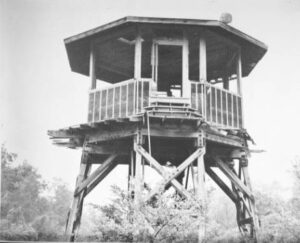
Guard tower at the Crossville, Tennessee, German POW camp – Tennessee Virtual Archives #7149, #CU052, copyright not evaluated
The guards were armed, of course, and always guarded the fence. Sentries with bayonet-tipped rifles patrolled the outside of the fence and kept anyone from getting too close. They did not want you hanging around the fence. About the closest we ever got was over there on the railroad tracks along the side, except for one time when the guard took me inside.
He referred to an incident several days after the prisoners arrived. Most children rarely wore shoes during the summer. While turning peach baskets one day and being barefoot at the time, Billy stepped on rusty barbed wire and cut his foot. He left it untreated for a couple of days until it became quite painful, resulting in a limp. Georgia Eldridge noticed him limping that morning and feared that the cut had become infected. She called one of the Army guards from the compound and asked him to take Billy to the POW camp so the German doctor could examine his foot and treat the cut.
“She told the guard to take me over there, and he did. The doctor looked at my foot and said, ‘Ya, ya, no lines, no lines. No blood poisoning,” which meant that no tell-tale red streaks were extending up the leg, signaling blood poisoning. The doctor spoke broken English while talking to Billy.
He continued, “He swabbed a little Q-tip-like object into the cut and cleaned it out.” Billy recovered from the injury and always appreciated the German doctor’s care that day. He was one of only a few locals who entered the German compound.
The Prisoners Work in the Orchards.
After a couple of days settling into their quarters, the prisoners began their work. Most were assigned to pick peaches. Each morning, the Army’s trucks shuttled prisoners and their guards to the Eldridge orchards, the largest in Sale Creek at that time. The Ell-Dee and partnership orchards were starting to shrink due to the loss of the twenty-eight-year-old Shipley Hill Orchard (over 100 acres) and the deteriorating condition of the massive Big Ridge Orchard (over 200 acres).
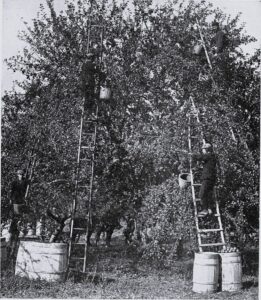
From Productive Orcharding, Modern Methods of Growing and Marketing Fruit by Fred Coleman Sears 1917 – Wikimedia via LOC and Sloan Foundation, no known restrictions
In addition to the pickers, some prisoners were assigned to work around the packing house. Al Davis explained that the only jobs the prisoners were permitted to do were (1) picking peaches, (2) loading baskets onto boxcars, and (3) unloading supplies. They were never allowed inside the packing houses where women, children, and older men worked.
One day, prisoners began unloading bundles of basket liners from a train car. Basket liners were made of cardboard or thick paper, placed inside peach baskets to prevent the fruit from bruising or being cut against the wooden slats. The liners, which nested within one another, resembled cupcake wrappers and were then wrapped in brown paper. These large bundles were what the prisoners unloaded that day.
As the work progressed, one of the bosses in the packing house noticed that the prisoners frequently dropped bundles from the train onto the ground, supposedly by accident. The curious prisoners hoped that one of the bundles would break open so they could see what was inside. Finally, the boss in the shed informed the burly sergeant about what the prisoners were doing. This sergeant was a veteran of the North African campaign and had been wounded in action there. He had been sent back to the United States to recuperate, which is why he was guarding prisoners in Sale Creek. Editor’s note: All or nearly all the prisoners of war had been part of Erwin Rommel’s Afrika Korps and had been taken prisoner in North Africa.
When the sergeant heard about the problem, he walked over to the prisoners and told them, “Now, I know that all of you let on like you do not understand English, and I know for a fact that you do understand English, so I’m telling you just one time. If one more bundle of liners hits the ground, there will be hell to pay.”
Al Ray Davis recalled that the remaining bundles were handled like eggshells. He said this incident dispelled the notion that the German prisoners could not speak English; many of them could, but they did not use it unless spoken to by an American or had a good reason to do so.
Dr. Thompson quoted from an Army inspection report:
On most days, POW labor worked out great; however, on July 23, 1945, the men did not perform the job as they had before. While that was never fully explained, it likely meant they did not reach their quota. Their U.S. military supervisor addressed this by requiring them to work longer the next day.
Lt. Luders noted on August 1, 1945, that the POWs had completed 276 person-days of work at the camp and 2,294 man-days in agriculture. Due to the effectiveness of the German POWs, in 1946, when the peach crop topped 90,000 bushels, orchard owners who still needed help lamented the unavailability of German POW labor.
The only other known behavioral issue by a prisoner involved an incident in which some of the graders on the sorting line noticed several peaches come through with swastikas scratched into the skins. They collected several specimens, called one of the guards, and showed him. He told them, “Just don’t worry about this, it’ll never happen again. I’ll see to that.” No one knows what happened, but the incident was never repeated.
The 247 prisoners did a commendable job saving Grover Eldridge’s peach crop. Nearly all the peaches were picked and shipped. Although there are no figures for the final count of bushel baskets, it was a profitable year for Eldridge.
Life in the Camp.
The Times article discussed the conditions and procedures of life in the prison camp. “The prisoners are housed in barracks (tents) which meet military requirements in space and sanitation. None of the prisoners worked with civilians, nor were they allowed to operate any types of machines, including the Army’s trucks.”
Billy Ray talked about the cooking arrangements for both the prisoners and the Army troops.
The POWs had their cooks. The prisoners did their cooking, and the Army did theirs. They had a bunch of portable kitchens across from the old peach shed. I’ve been down there early in the morning before we started work and have seen smoke rising from their fires over here and from the Army’s fires over there.
Although specific menus at the Sale Creek camp were never mentioned, Thompson discussed the Memphis camp (and likely all other POW camps). The prisoners claimed, “The food seemed to be the best in the world. We didn’t have such food in the German army.” Foods such as Southern fried chicken, fried catfish, and peanut butter sandwiches were introduced to the prisoners. The biggest complaint from some prisoners at various camps was that there were not enough potatoes. The U.S. Army supplied the food, but the prisoners’ cooks prepared most of it, adding their cultural taste.
The Geneva Convention stipulated that prisoners of war should receive the same caloric intake as soldiers in the American army, particularly if they were engaged in strenuous physical labor, as was the case with the peach workers. In some instances, the daily caloric provisions totaled 4,000 calories.
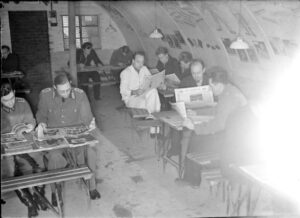
German Prisoners of War in Britain from Everyday Life at a German Pow Camp, 1945 – Wikimedia via Imperial War Museum, pub dom
Billy Ray mentioned another amusing facet of the Army’s and prisoners’ stay in Sale Creek. “The guards asked us one day where a good swimming hole was, so we told them. We took them to the Boom at the foot of the mountain. They used to take us up there to swim every day. They were the only ones with enough gas in a truck to get there and back daily.”
Another problem arose that involved swimming. On July 23, 1945, two Army officers – Captain W. J. Bridges and Captain C. E. Tremper – inspected the camp. In the report, Captain Bridges complained about an action taken at the camp where Army trucks had been used to transport the prisoners to a nearby lake (most likely Patterson Lake) for swimming. Bridges stated, “I worried that this could cause comment and unfavorable criticism by local civilians.” However, the camp was so short-lived that any criticism never had enough time to fester.
That complaint needed to be tempered by the fact that the prisoners were picking peaches all day long. What was one of the most common complaints about peach picking? Peach fuzz. It is itchy, finds every human body’s crevice, and “itches like all get out!” The best way to get relief is by bathing, so trips to the lake were not just pleasure outings. The lack of available resources to wash off the fuzz and cleanse the body and clothing at the camp could be seen as cruel treatment by anyone who has ever spent time in a peach orchard or packing house.
Browne mentioned in her article that the prisoners were “guarded at all times, but that the guards had a light job because the prisoners acted diligently and satisfied in their work and had shown no inclination to escape.” This may be an oversimplified description of the prisoners’ lives at the time and seems intended to present an overly rosy picture of their conditions at the camp. For the most part, her description is accurate. Overall, the prisoners’ stay at Sale Creek was relatively pleasant and non-eventful for all parties involved.
Demographics of the Prisoners.
The prisoners represented a typical cross-section of German society, encompassing all classes. The average age of the prisoners was twenty-six. Among them were many former college students, two college professors, and numerous experts in scientific agriculture, forestry, geology, and chemistry. One former music teacher was even included in the group. One of the Sale Creek World War I veterans remarked to the reporter, “They seem so different from the German soldiers of the other war. These are not the typical German military type – they are a cross-section of all classes.”
However, the prisoners’ success in picking the peaches was only part of the Peach Picking Afrika Korps story. The other side was the human side. What was the impact of the German soldiers on the local population, and what was the reverse effect?
By the time the prisoners arrived in town, the war in Europe had ended, and the Pacific War would soon conclude with the dropping of two atomic bombs. Eighteen men from Sale Creek, Coulterville, and Bakewell had lost their lives. With so many young local men killed or injured in Europe and North Africa, strong sentiment existed against the presence of the German prisoners.
Al Davis recalled, “I heard comments about that. Many people disliked having them here and resented and hated them for what they had done and stood for. Even still, I heard many people speak with compassion about the plight of the Germans in the camp.”
Many parents forbid their children, especially young girls, from going anywhere near the prison camp, but that did not prevent several from venturing there occasionally. One member of the Hoffman family of German descent visited the compound one evening to check if any Hoffmans were on the camp roster.
One young lady named Loretta Troutman Defriese went there one night and shared her experience with me. She was near the camp with some other girls when she noticed a handsome young man standing at the fence, looking in their direction. Later, she received a note from the German soldier expressing his desire to talk with her. In the note, he mentioned that he was originally from California but had gone to Germany to fight when the war began. He was captured early in the war in North Africa and ended up at Camp Forrest. Loretta said that she did not go back to see the young man because, first, she was afraid of what people in Sale Creek might say about it, and second, she was scared to talk to him.
Another seventeen-year-old woman, Virginia (Boots) Lane, the daughter of local store owner Dolph Lane, recounted being part of a group of young people who walked past the camp one evening. As they approached the compound gate, they sang a song to the men in the enclosure. To their surprise and astonishment, the prisoners responded by singing a German song back to them.
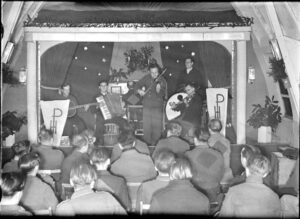
German POW musicians and audience from Britain’s Everyday Life at a German POW Camp 1945 – Wikimedia, pub dom
Multiple people remembered the Germans singing during the day while working around the packing house and in the evenings. Billy Ray, his brother Donald Ray, Willard Hodge, and Tom Crawley all said that a crowd of local people often gathered at the compound to hear the prisoners sing at night. Billy recalled, “Yeah, we sat on the railroad tracks, and they’d be over in the camp just having a big time. There would be a pretty good crowd of people listening to them. They sang some good harmony, too. It was pretty good singing.”
Vivian Browne reported,
One prisoner was a music teacher, and many were splendid singers. Their first night in Sale Creek, there was an evening barracks concert of German folk songs, and the townsfolk enjoyed it thoroughly because it could be heard a mile away.
Tom Crawley also recalled the prisoners singing in the compound. He remembers being close friends with Johnny Shipley in high school and spending several nights at the Shipley home on Leggett Road, while the prisoners were at the camp. After completing their work for the day, he and Johnny occasionally walked to the compound and listened to the prisoners sing. He always enjoyed hearing their German songs.
Al Davis also spoke about another singing event at the compound. He recalled an incident in which a group of townsfolk put together a small entertainment show. After securing permission from the camp commander, the troupe went inside the compound one night and performed for the prisoners. One of the performers, Robbie Dean Hoffman Waller, said the group was comprised of her and several friends and relatives.
A Lasting Legacy.
Tom Crawley shared a story in 1990 that adds a different dimension to the entire prisoner-of-war camp narrative. In an interview about the camp, he recalled a conversation with a man from several years earlier. During their discussion, the subject of the camp arose, and the man reminisced about an afternoon television program in which a German couple touring the United States appeared. The program’s host asked the couple whether they had ever been in the United States. The husband replied that he had spent time as a prisoner of war in the South, and while there, he had picked peaches in a town called Sale Creek, Tennessee.
Perhaps the longest-lasting effect of the POW camp involved one prisoner and Jack Elsea, Sr., who worked as the foreman for Grover Eldridge from 1930 until Grover sold his holdings and moved away in the fall of 1946. Jack supervised the forty original prisoners who arrived in the spring of 1945. During that time, he developed a friendship with one of the English-speaking prisoners. When that group of prisoners left Sale Creek to return to Fort Oglethorpe, Jack gave him his address and told him to write to him occasionally to let him know how he was doing. After the war, Jack and the former prisoner communicated several times by mail.
Although the brighter side of the prisoner-of-war story was often emphasized, the reality remained that immense tragedy brought all parties together. The life stories of German prisoners represented numerous tales of suffering, loss of freedom, and heartbreak. Nevertheless, many lives were meaningfully impacted as people from two nations and cultures connected in a small Tennessee town through hard work, music, song, and conversation. In the case of Jack Elsea, this led to the formation of a long-distance friendship that lasted many years after the war. Jack Elsea’s great-granddaughter, Becky Benefield, stated, “They became very good friends and continued to correspond after the war. The former prisoner made lace doilies and sent them to Daddy Jack as gifts; we probably still have them. The man was nice, just caught up in the war defending his country.”
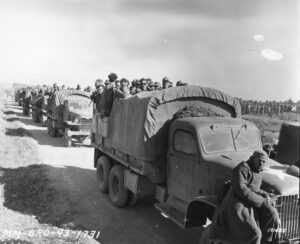
U.S. Army trucks full of German prisoners, 1943, photog. Grosham – Wikimedia, pub dom
On August 10, 1945, the camp was dismantled and loaded onto Army trucks. The prisoners boarded other waiting vehicles for their journey back to Camp Forrest. The mission of the Peach Picking Afrika Korps was complete; the 1945 Sale Creek peach crop had been saved, and an indelible chapter was written in the history of the town.
The 1946 peach crop totaled 90,000 bushels, and once again, there was a labor shortage, but this time, there was no Peach Picking Afrika Korps to lend a hand. At the end of that packing season, Grover Eldridge sold all his land, tore down the packing house, and ended his strawberry and peach empire. Then, he moved to Florida and used his earnings to launch a rental property business. The Ell-Dee dissolved at about the same time, leaving only a handful of small peach growers who struggled until August 12, 1953, when the whole business collapsed with the death of the last peach icon, Jack Kenney.
Memories of the prisoner-of-war camp and the legendary peach business are fading echoes in the minds of a few elderly people who remember those days. It would be interesting to know the thoughts of the German descendants whose family members visited Sale Creek as prisoners of war in 1945, leaving a lasting impression on many locals. I wonder what memories they have of Sale Creek.
Curtis’s article appears in Chattanoogan.com as “Peaches and POWs in Sale Creek” and in Coulter’s The Creeker Magazine as “The German POW Camp of 1945.”
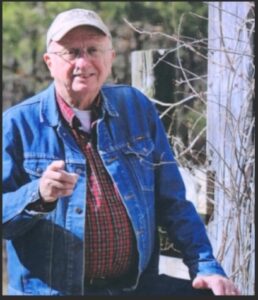
As a sixth-generation native of Sale Creek, Curtis Coulter’s roots run deep in the town where his ancestors were original settlers in 1819. He is the author of five books, numerous periodicals, published geographical maps, and other historical information about the communities of Sale Creek and Coulterville. Retired after a 40-year career with Hamilton County Schools, he continues to live in Sale Creek with Alice, his wife of fifty years. There he remains deeply committed to his community’s past, present and future.
Danielle, Thank you for your interest in my books. The story of the German POW camp is contained in my publication, The Creeker Magazine, along with three other stories from my community of Sale Creek. If you are local, you can get my books at the Sale Creek Post Office or at The Gathering Place in Dayton. They are available on my website coulterpublications.com as well.
Loading...
Hello Danielle,
I’m glad you found the article as fascinating as we did!
If you’re looking for “Axis Prisoners of War in Tennessee” by Dr. Antonio Thompson, it is available through local book stores or can be found online. If you search by the title a number of options will come up for you.
Good luck in your search and thank you for reading Appalachia Bare!
Tom Anderson,
Admin
Loading...
“U.S. Army 1st Lt. John B. Luders, from Lawrenceburg in West Tennessee” ~
1st Lt. Luders had been an officer at the POW Camp in Lawrenceburg in southern Middle Tennessee. That POW Camp had been established in April 1944 and was occupied until March 1946 with approximately 350 German POWs . He was probably reassigned to his new position because of his experience with those POWs at Camp Lawrenceburg.
We are presently working with Lipscomb University on researching over 350 letters written by the ex-German POWs at Camp Lawrenceburg to people in the Lawrenceburg area. We have also worked with Dr. Antonio Thompson at Austin Pea University about those POWs.
– Curtis Peters –
President, Lawrence County Historical Society clpeters@charter.net

 As a sixth-generation native of Sale Creek, Curtis Coulter’s roots run deep in the town where his ancestors were original settlers in 1819. He is the author of five books, numerous periodicals, published geographical maps, and other historical information about the communities of Sale Creek and Coulterville. Retired after a 40-year career with Hamilton County Schools, he continues to live in Sale Creek with Alice, his wife of fifty years. There he remains deeply committed to his community’s past, present and future.


Where can I buy these books?
Danielle, Thank you for your interest in my books. The story of the German POW camp is contained in my publication, The Creeker Magazine, along with three other stories from my community of Sale Creek. If you are local, you can get my books at the Sale Creek Post Office or at The Gathering Place in Dayton. They are available on my website coulterpublications.com as well.
Hello Danielle,
I’m glad you found the article as fascinating as we did!
Mr. Coulter’s books can be ordered directly from his website, https://www.coulterpublications.com/.
If you’re looking for “Axis Prisoners of War in Tennessee” by Dr. Antonio Thompson, it is available through local book stores or can be found online. If you search by the title a number of options will come up for you.
Good luck in your search and thank you for reading Appalachia Bare!
Tom Anderson,
Admin
“U.S. Army 1st Lt. John B. Luders, from Lawrenceburg in West Tennessee” ~
1st Lt. Luders had been an officer at the POW Camp in Lawrenceburg in southern Middle Tennessee. That POW Camp had been established in April 1944 and was occupied until March 1946 with approximately 350 German POWs . He was probably reassigned to his new position because of his experience with those POWs at Camp Lawrenceburg.
We are presently working with Lipscomb University on researching over 350 letters written by the ex-German POWs at Camp Lawrenceburg to people in the Lawrenceburg area. We have also worked with Dr. Antonio Thompson at Austin Pea University about those POWs.
– Curtis Peters –
President, Lawrence County Historical Society
clpeters@charter.net